One Thousand Voices: landscape, memory and immersive storytelling by Martin Sercombe
Introduction by Sarah Tremlett
Immersive storytelling can be many things, but in terms of poetry film it provides a great opportunity to extend into the world of theatre and performance in a unique way, doubling the reach of the film’s capabilities and audience, and expanding how creatives work together. For example, I read a family history-based poem in front of its associated poetry film (adapted to run without text) on just a small screen in Vancouver and also San Francisco. A poem can be born again in many iterations. As such I am really pleased to discover the New Zealand-based Wordcore Wayfinders Project which I sincerely wish were closer to home! Leading poetry filmmaker Martin Sercombe, who has been featured in Liberated Words before, shares with us both his experience of making a poetry film for an immersive presentation, and the making of the poetry film itself.
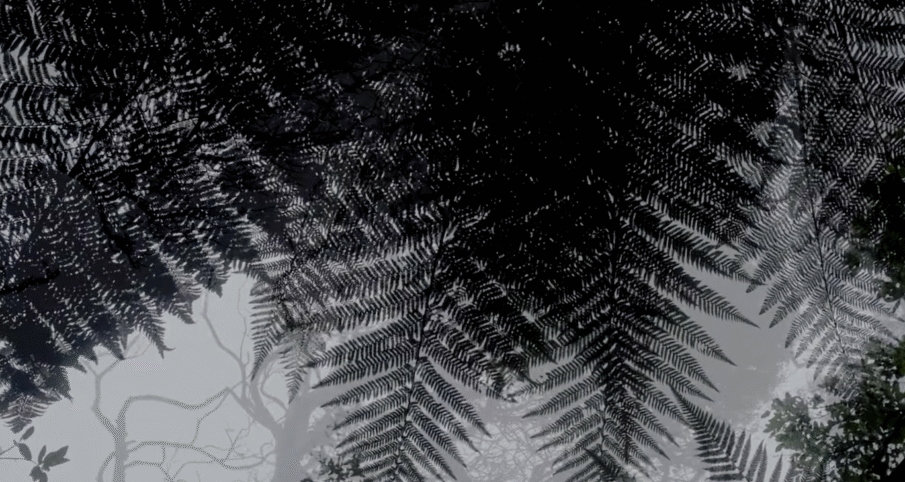
Working on my family history poetry film project TREE, I have ventured across many diverse landscapes in search of places to call home. One Thousand Voices with poem and voiceover by New Zealand poet Paris Whitehead, film by Martin, immersive soundscape by Paul McLaney and location sound by Britta Pollmuller, is a consummate exercise in melding the elusive relationship between family memories and landscape. The veracity of the poet’s voice, its cadences combined with a flowing, almost unpremeditated use of language, is one of the most successful I have heard in conveying a sense of reaching out to nature to try to reclaim paternal loss. Martin’s evocative use of the camera, often shifts between sublime, understated perspectives and patterned close-ups (e.g. ferns) to enhance the narrative. The addition of sounds captured on location provide exquisite, diamond-like moments, set against the moving, melancholy music, such as running steps at the end and something thrown into the unseen water.
The description on YouTube could not be bettered so I will repeat it here:
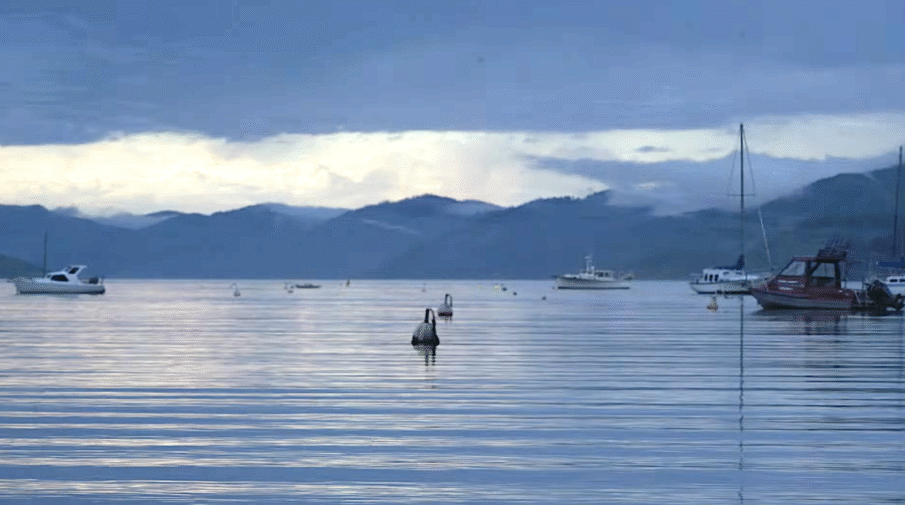
‘One Thousand Voices is a film poem, a fractured elegy shaped by memory, dislocation, and a yearning for belonging. Through Paris Whitehead’s layered and intimate spoken text, the protagonist moves through landscapes that offer both solace and sorrow. Nature becomes a charged terrain where absence echoes and memory takes root. The spoken text finds its visual counterpart in Martin Sercombe’s cinematography, which traces the South Island’s elemental geography: the limestone headlands of Te Hapu, the shadowed fern bush of Hokitika and tidal mud flats at dawn. Each location becomes an emotional cartography, mapping internal states through the language of wind, water, rock, and light. This three-way dialogue is completed by Paul McLaney’s immersive soundscape, composed from field recordings and live instrumentation. His score flows organically with the imagery and voice, blending breath, birdsong, and echoic tones into a sonic weave that holds the work’s emotional resonance in tension and release. In essence, the film is a meditation on loss, ancestry and the fragile threads that bind memory to landscape. Through Paris Whitehead’s layered and intimate spoken text, the protagonist moves through landscapes that offer both solace and sorrow.’
Martin has kindly given us an insight into how the film and the project as a whole came about.
The Wordcore Wayfinders Project: A Personal Journey by Martin Sercombe
Wordcore Wayfinders Aotearoa was founded in 2024 by Christian Jensen and Shane Hollands to explore immersive storytelling through the fusion of art, moving image, words and music. In December of that year, work began on a major group show that would embody this vision: Illuminated Horizons.
Christian brought together a network of poets, musicians and artists, grouping them into trios to foster collaboration across disciplines. I was invited to join one of these trios, alongside poet Paris Whitehead and composer Paul McLaney. For me, this invitation marked both an exciting challenge and an opportunity to push my own creative practice into new territory — one where my moving-image work would no longer stand alone but exist in dialogue with live music and the spoken word.
Our process began with a series of informal meetings to find common ground and devise our approach. We decided that I would start by creating a visual travelogue: a portrait of South Island landscapes, filmed in ways that might suggest not only geography but also rhythm and tone. These landscapes were chosen less for their iconic beauty than for the moods they carried: the play of mist across tidal flats, the weight of limestone cliffs, the density of fern forests. My partner, Britta Pollmuller, captured the sound textures of these environments with a field recorder and shotgun mic.
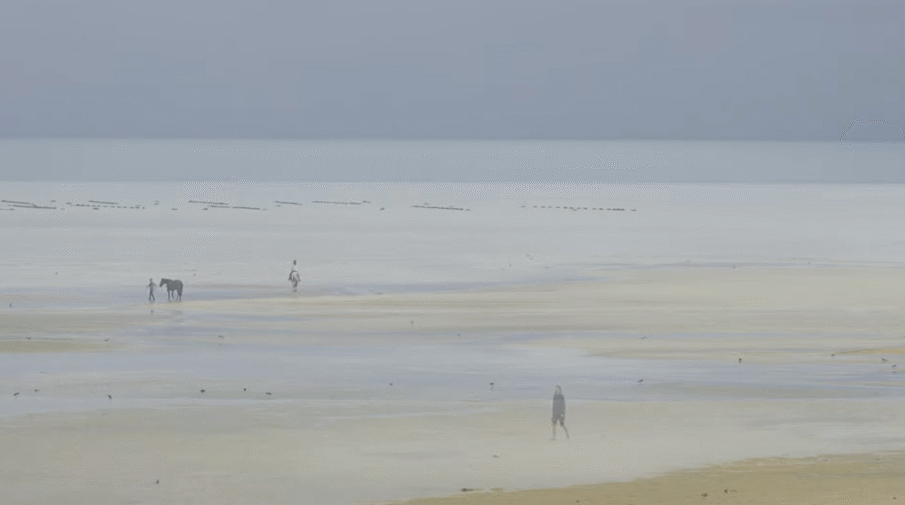
Returning to Auckland, I assembled a first edit of the footage. Rather than impose a single narrative, I shaped it into a series of episodes, each reflecting the atmosphere of a particular location. This assembly became my offering to the collaboration: a framework of images and sounds waiting for other voices.
Paul then took the material and responded musically, weaving ambient soundscapes out of reprocessed natural recordings and live instrumentation. His compositions didn’t just accompany the images; they seemed to breathe with them, amplifying their inner pulse. Paris, in turn, brought in a poetic voice that threaded through both image and sound. She chose to write from the perspective of a protagonist moving through the landscapes, evoking personal memories that carried both solace and sorrow. Her writing transformed the visual journey into something more than geography: a cartography of emotions, both light and dark.
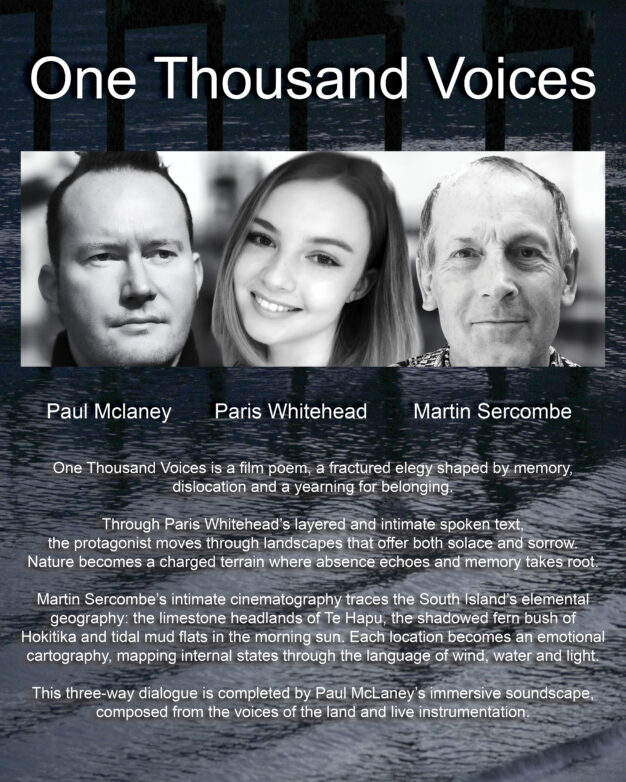
Together, we named the work One Thousand Voices, a title that captured the sense of polyphony: poet, filmmaker, composer, landscape: speaking in unison. Two versions of the film were cut: one designed for theatre screenings with Paris’ recorded narration, and another stripped of narration, so the imagery could serve as a living backdrop to her live performance.
The Illuminated Horizons Show
When Illuminated Horizons premiered in August 2025 at Te Puna Cultural Hub, I experienced our work within the larger constellation of five other trios. The evening was held together with warmth by MC Allana Goldsmith, whose humour, waiata, and audience engagement framed the event as both performance and community gathering.
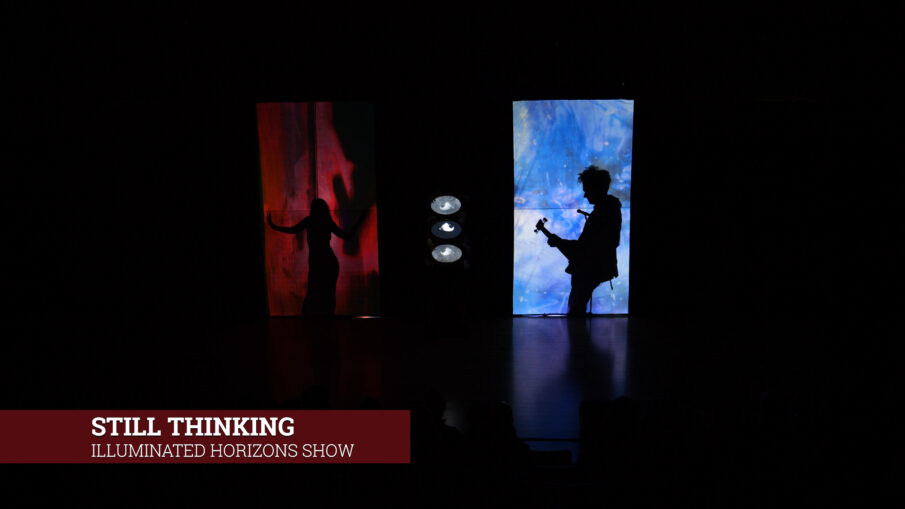
The opening act, Still Thinking — the duo of Lucie Blaze and Mitchell Vickery — set the tone with Shadowland, a work that felt simultaneously theatrical, cinematic and musical. Projected shadows of the performers moved across twin screens, merging with live guitar, poetry and a central sculptural installation of blinking eyes. The work occupied a cross media space: not quite a band, not quite theatre, but a haunting hybrid that asked us to reflect on the masks we wear and the selves we conceal.
Then came our trio’s One Thousand Voices. Paris stood beside the projection, delivering her poem live. In the final sequence, she drew fragments of text from a black bag, reading each one before letting it fall like a leaf into the dark. Behind her, the landscapes I had filmed shifted and transformed, merging with Paul’s score and the spoken words. Watching it unfold in front of an audience, the work felt very much like a shared act of storytelling that lived between us and those watching.
The second trio, Blank and Empty Boxes, took a playful turn. Lex Shoemark, Noah Brown, and Luani Nansen explored Polynesian and Māori identity through rap, storytelling and improvisation. Their performance balanced humour and poignancy, breaking the fourth wall while reflecting on family histories, present struggles, and future hopes.
The second half opened with Mono Watt. James Littlewood’s spoken and sung texts, layered against Ross Cunningham’s driving guitar noise and John Pain’s electronic textures, created a raw and expansive soundscape. Their work felt like standing at the fault line between intimacy and chaos: songs about relationships and social power delivered with both delicacy and force.
Collaboration remained a central theme in Worldbuilders, where Jade Lewis and Hon Manawangphiphat joined Sally Legg in a lively cross-disciplinary exchange. Blending stop-motion visuals, indie-pop energy, and narrative invention, the piece embodied its title, presenting not just a performance but a process of co-creation involving a huge collection of domestic bric-a-brac, rugs and detritus.
The evening closed with Tangaroa’s Realm, a tour-de-force by David Eggleton with Richard Wallis and Ronald Andreassend. Eggleton’s rapid-fire delivery — at once surreal, satirical, and musical — drew on decades of poetic tradition while remaining strikingly contemporary. Wallis’ guitar and Andreassend’s hanging sculptures expanded the performance into a cabaret of cultural and political critique. At one point a painted umbrella acted as a cue for Eggleton’s hilarious and dynamic play on the word itself and the object’s uses. It was a fitting climax: Aotearoa refracted through myth, satire and sound.
Future Plans
The team has established funding for a series of production workshops, which will lead up to Illuminated Horizons II, on National Poetry Day 2026. It now has a permanent office space at Te Puna Creative Hub, where it will plan the annual show, alongside a range of spinoff projects. Examples include collage poetry workshops and a pop up activation for Auckland Live Summer in The Square.


