Cadence Video Poetry Festival: Messages from America – Light in the Darkness
Now in its ninth year, Cadence Video Poetry Festival (the brainchild of Chelsea Werner-Jatzke and Rana San) is now in full swing at the Northwest Film Forum in Seattle, USA. Celebrating National Poetry Month (in April in America), this year you can see a wide variety of genres, with live and online screenings (taking place in person April 17–19 at Northwest Film Forum, and online April 17–30) with two artist gatherings. The Sunday matinee includes new work created by participants in the Dreaming Ecosystems: Film Poetry Workshop, led by poet Mita Mahato and filmmaker Caryn Cline. Thoughtfully, the directors have also initiated a Poetry Bookshelf [Online]: for publications by Cadence artists: cadencevideopoetry.org/bookshelf
As they say: ‘The festival’s five showcases and two satellite screenings include the outcomes of a generative workshop and more than 50 video poems from 21 countries in 18 languages, with 19 World Premieres and 11 US Premieres! It is the only festival of its kind in the Pacific Northwest. Works featured are from an open call for submissions, new work from Cadence workshop participants, and pieces from the Cadence programming team. Pacific Northwest video poets contribute over a quarter of the works in the whole festival,” notes co-director Rana San. “We’re proud to be an international festival with excellent regional representation.” In a fascinating piece of information which bodes well for the genre, apparently, 84% of films are by artists Cadence has never shown work from before.
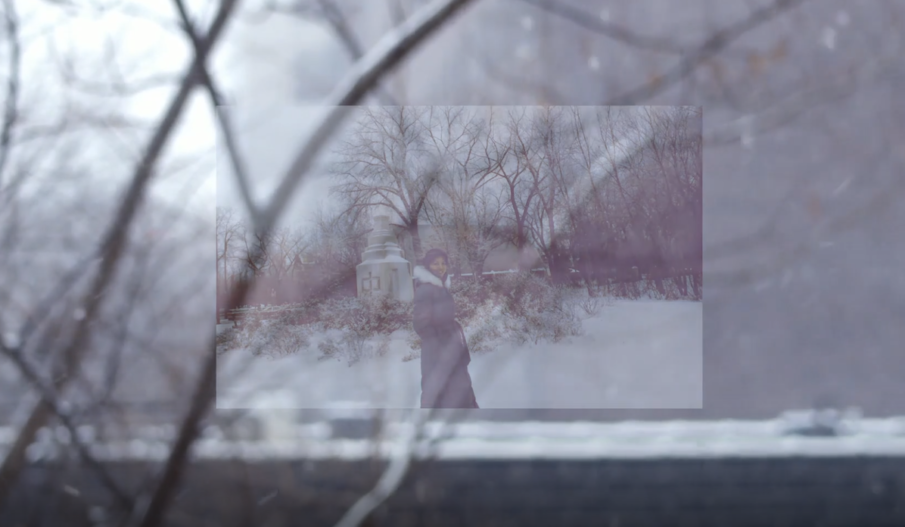
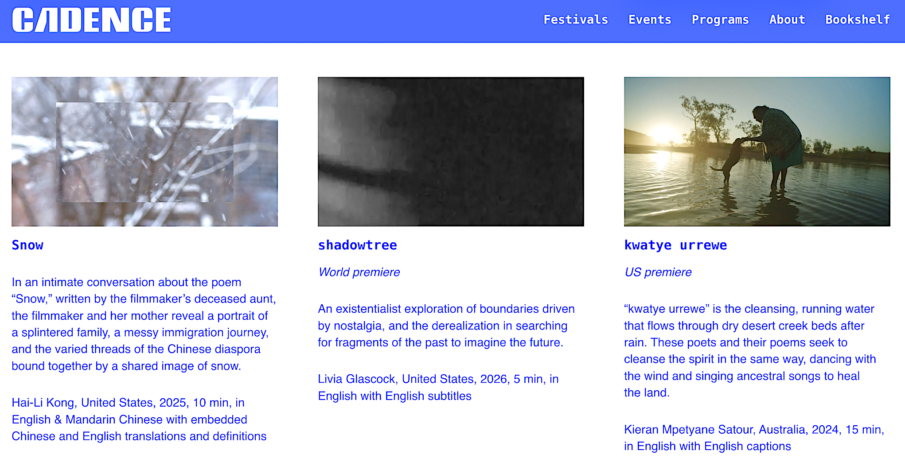
Snow, Hai-Li Kong, USA, 2025.
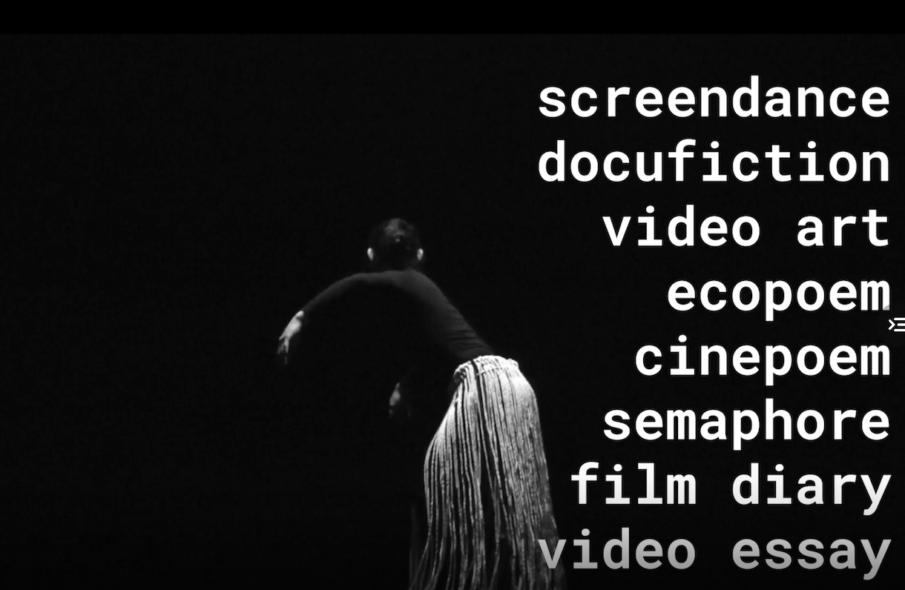
“Unique to the 2026 festival is the screening of a feature-length video poem from Belgium in 10 languages. This is only the second time Cadence has presented a long-form video poem at the festival, and we’re excited to share the US premiere on Sunday evening. Accompanied by a screendance from Mexico, this showcase wraps up the festival showcases with an appeal that we cherish the collective memory created by poetry.”
Short film programs at NWFF (online Apr. 17–19; in-person showtimes listed below)
- April 17, 7pm | you flew from my eyes: Giving shape and voice to what’s felt but can’t always be seen, touched, or retrieved, these video poems meditate on the marks we leave and with which we are left. Between earthly boundaries and open sky, dances, phone calls, and a trampoline become buoys for self and other within the sea of time.
- April 18, 4pm | the gaps in me: What lies beyond the watery weight of a body? Do mirrors reflect the dusty light of truth? Part ghost story, part performance art, and part art object, these video poems forsake flesh and revel in repetition. Emerging from the sand and slime of our collective grief, they reveal the shared realities of loss and persistence, as told through sutures, similes, and mise-en-scènes.
- April 18, 7pm | a sculpture of echoes: Vegetal time meets time travel, demonstrating the subtle ways in which we are interconnected and influenced by our environments. Urban infrastructure defines new habitats, the hand that feeds nourishes a new intimacy, and a surreal spell brings new life into being. Creation myth, memory, humor, and history combine in unexpected ways as these video poems ask: Is it cake? Or is it chaos?
- April 19, 4pm | proof that we were here: Inventing realities not as escapism but as determinism, these video poems perfect the alchemy of dreaming. A love story emerges out of the polluted atmosphere, plant life blooms into a collage of words, and ice melts into a procedural poem. Through new channels of communication with nature, these shapeshifting films prove that the key to providing a sustainable future is protecting the past.
- April 19, 6:30pm | an imperceptible mark: Tracing a multilingual lineage through the condensation of our collective memory, this showcase peers into the abstract spaces of female poets. A feature-length video poem and an accompanying screendance expand our understanding of mother tongue and of presence, even in absence. Have we forgotten what the women before us bore, broke, and buried to survive? A chorus of layered voices invites us to remember.
Satellite screenings:
April 14, 2026 A Current Wells Inside at Boathouse Microcinema, Portland, during Portland Panorama!
- April 30, 6pm | ceaseless, of the earth – closing showcase at Frye Art Museum; and a showcase in conversation with the fertile ground of the floral still life explored in the Frye Art Museum Wallflowers exhibition.
- July 2, 5–8pm | imagine a mountain running – Free First Thursday at Seattle Art Museum
A showcase in conversation with the lucid dream depictions of landscapes and daily life exhibited in Beyond Mysticism: The Modern Northwest at Seattle Art Museum.
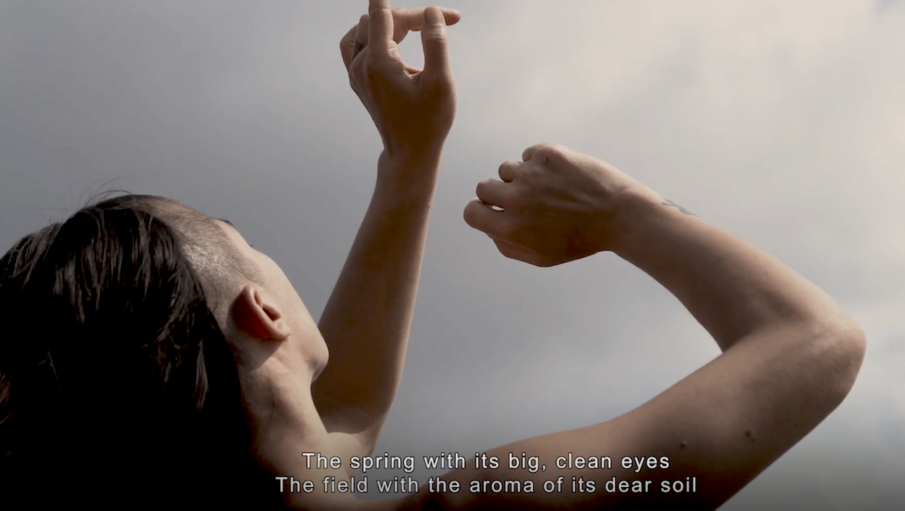
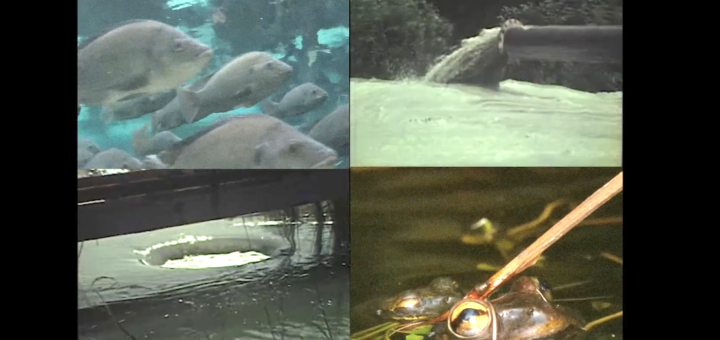
The Sky After Rain, Aseman Bad Az Baran, Australia, 2021.
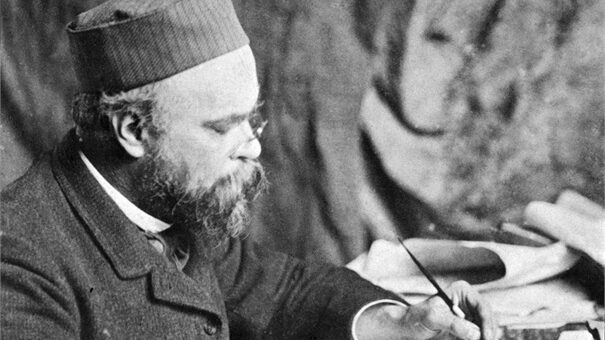
I was fortunate enough to be included in the satellite screening at Seattle Art Museum in July, with my family history poetry film Nocturne for a Lighterman. I particularly like this happy conjunction because the film includes the painting Nocturne: Blue and Gold – Old Battersea Bridge (1872–5) by American artist James McNeill Whistler (1834–1903). I like to think he would have been happy to ‘come home’ in this way. More importantly, this allows me to have open access to all the films, and I am thrilled to have such a finely curated selection on tap this month. Each programme takes pains to match films together in a very attuned way, and so narratives seem to reflect each other and continue a joint conversation. Not only this, but the very thoughtful way they have presented the films onscreen, with descriptive details alongside, is extremely helpful. Whilst it is best to follow the descriptions and contextual information from the festival itself, I would just like to say a few words about the first main event in Seattle.
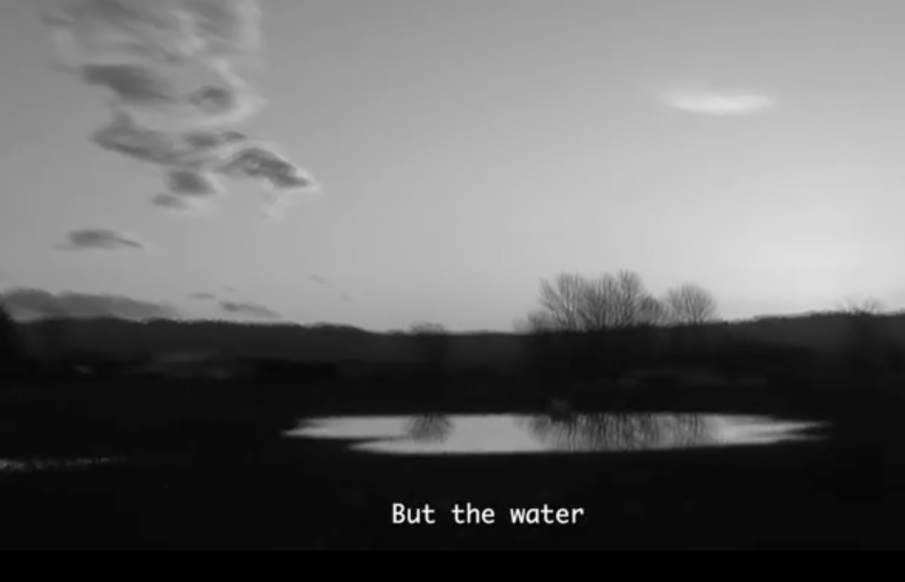
shadowtree, Livia Glascock, USA, 2026.
you flew from my eyes
‘Giving shape and voice to what’s felt but can’t always be seen, touched, or retrieved, these video poems meditate on the marks we leave and with which we are left. Between earthly boundaries and open sky, dances, phone calls, and a trampoline become buoys for self and other within the sea of time.’
In this richly international programme, all the nine selected films could be described as video diaries or video essays, with varying lengths. As someone used to watching much shorter poetry films I found these works liberating. Also the binding of factual information with experiential and expressive emotions over longer, perhaps a more fluid time frame, quite accessible and thought-provoking. To this end, I myself have been working in a longer more personal format recently. However, mostly I realised that having direct, first-hand accounts on film of this world today feels like the most important way to communicate. And I applaud each and every one of them.
All the films reflect the world in crisis, the climate catastrophe and political exile and or dispossession, and the importance of nature in enriching our souls (particularly at this moment in time). Many of these films were spoken with lack of faith in the planet’s survival, either through climate change or the governments who aren’t effecting change. In some cases, the elemental nature of this curation: desert, snow, rain, water, the sea, came with hope, but for others complete resignation. Total connection to land, a spiritual connection to land was front and centre, alongside family history and ancestry.
At this time of constant bombardment not only in physical locations worldwide, but by media coverage, the fragility of most of the films is a reflection of the states of mind of the narrators, who like all of us have concerns for human rights and the future of the planet. It is as if we are on a precipice, as in the flower image in the film Oracle (by Youssef ElNahas and Leena Aboutaleb) about the love of the Mediterranean Sea. We see the turquoise blue water and the sun, but also how the sea brings adversity and presentiments about encroaching unrest: ‘the edge of the world cradling us’. In truth, all of us (East and West) are mentally on our knees asking regimes to stop and become accountable and listen to the people. Idealism is over. Cynicism is prevalent. Who are the leaders we can have faith in? Ecological systems must be put in place, as much to provide water and sustenance, as saving species. How can we fight corruption at the top that insinuates itself into the decisions of world leaders and will not be stopped?
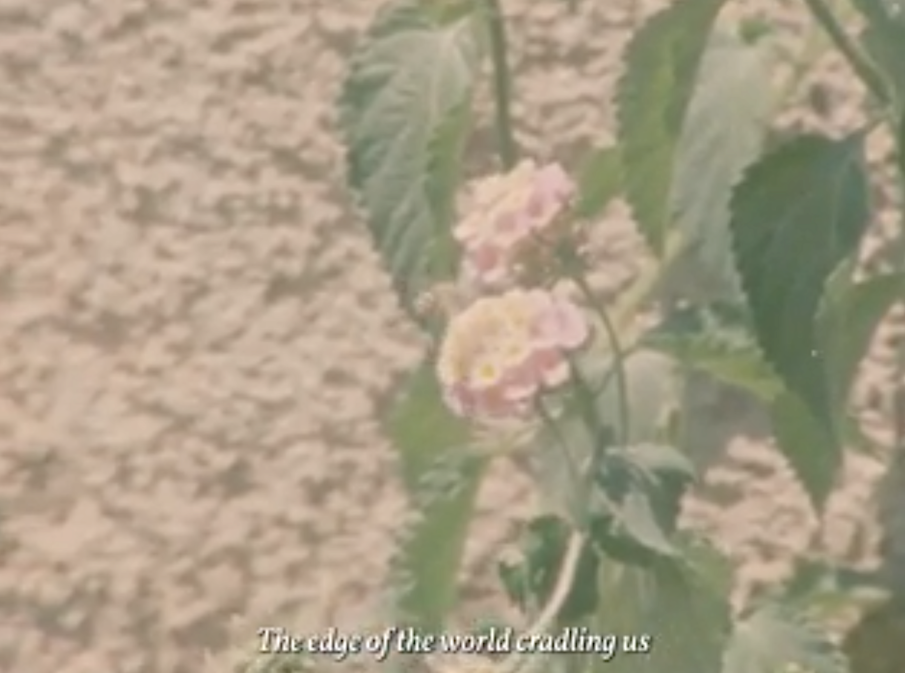
Oracle, Youssef ElNahas and Leena Aboutaleb, Egypt, Palestine, United Kingdom, 2025.
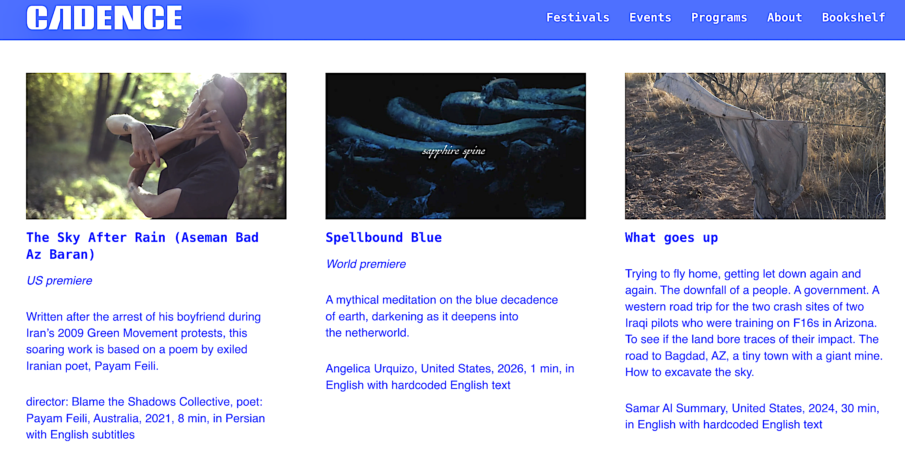
Whilst I cannot go into every film, in What Goes Up US-based artist and writer Samar Al Summary shows us the intermeshing historical complexity of her own and the broader relationship between the military in America and Iraq. Here, with a journalistic narrative style, we encounter the hidden stories of two Iraqi airmen training in the US, whose planes crashed in Arizona. This quest is combined with her need to return home. An inspired approach to filmmaking uses a trampoline to create shots of her waving, jumping in and out of view of the camera, denoting her attempts to get attention outside the wire fence of an airbase.
In terms of the construction of all the films, each brought a delicate tonal quality, (textural, misty or using blinding natural light) and/or gentle voices (enhancing by contrast the terrible, all-consuming context). These were set alongside fractured, partially visible, or random visuals (sometimes offering wonderful juxtapositions with text on screen) defined by some truly innovative soundscapes. All were drawn from a duality (perhaps always a historical force): a love of the land and belonging against abuse by political regimes where the experiences of the individual show us the truth of the system. How ‘the other’ is a ‘normalised’ term to make war in order to take resources. The drive to expose the ‘real’ behind the ‘fake news’ of warmongers, of the disappeared being given a voice, the search for factual information where apparently none exists, establishes how we are all lone voices in the face of government dealings (and let’s not forget it). But please take note, these films cannot be repressed, where the vatic voice (bordering on elegy) though quietly assured, rings loud and clear. Each deals with the unspeakable nature of the subject matter, in a sensitive yet darkly informative way. We feel their experience and their bravery. Here filmmaking can give us humanity at its best. A maternal point of view where we value life itself for all creatures and the strength to survive.
Cadence Video Poetry Festival 2026
(In-person Apr. 17–19; Online Apr. 17–30)
Festival Information: cadencevideopoetry.org/festival/2026
Festival Tickets: filmfreeway.com/CadenceVideoPoetryFestival/tickets
Virtual Festival: cadencevideopoetry.org/festival/2026-cadence-virtual-festival