DEADEYE: a poetry video response to an environmental catastrophe – Ian Gibbins, January 2026
I have known the leading Australian poetry filmmaker Ian Gibbins for a number of years now, and marvelled at his skill as both an auteur poet and filmmaker, as well as his extraordinary evolution from an earlier life as a neuroscientist. However, unfortunately his work has become more and more prescient, timely and relevant. His environmental films document and shed light on the overwhelming changes that are happening to our planet on a daily basis and which we might feel powerless to prevent. In terms of climate change, many of us find the impact of loss to nature too overwhelming, shocking and affecting and we are suffering from our own eco grief. We have to make a choice. As artists we can turn away or, like Ian, confront what is happening and through our art and volunteering, work with the authorities to try to find solutions. Here he takes us into the very heart of a recent horrendous toxic eruption, devastating South Australian marine life, and literally taking the breath out of living creatures. With his love of the ocean and surfing, this affected Ian very directly. However, it also turns out that with his particular background across the sciences, he was also the right person in the right place to advise on marine biology and analyse the causes and effects of global warming. Ian not only makes videos but he gets involved in giving talks and discussions with ‘key citizen scientists’, providing much needed hope through sharing information. He also has put together data to create an overview that can demonstrate what is happening and why. His video Deadeye (see below) is an emotional, moving and arresting series of stills of the eyes of dead fish, alongside a soundscape created from their living counterparts, before the deadly bloom struck. With lines such as: ‘they used to think that the last thing you saw before you died remained etched on the back of your eyes’ it has never failed to bring a tear to my eye. As poetry filmmakers we can often be witnesses and/or take a vatic role that we can share on platforms worldwide. Ian has stepped one stage further: as a scientist he has also brought experience and knowledge to bear on a critical situation, thereby, in some way, effecting real change for the planet.
Sarah
DEADEYE
Ian Gibbins
All art is political, whether we like it or not. So, what is the place of art in the midst of environmental catastrophe? Can art ever fully communicate our lived experiences and emotional responses to disaster? When ecosystems collapse, is it possible for art to influence public policy?
Since the middle of March 2025, South Australian coasts have been afflicted by a harmful algal bloom of unprecedented size and duration. The effects of the bloom on marine life have been devastating, with hundreds of thousands of dead creatures, from tiny worms to large sharks, washing up on beaches along hundreds of kilometres of coastline. Underwater surveys indicate that mortalities seen on the beaches are only a small fraction of what is happening off-shore.

This bloom primarily consists of dinoflagellates, a remarkable group of microscopic single-celled planktonic organisms. They are classified as algae, since they contain chloroplasts and carry out photosynthesis. However, they are highly motile, moving quickly by the combined activity of two whip-like flagella. Furthermore, many species actively feed on other plankton. When conditions suit them, they can quickly proliferate and dominate the ecosystem by their sheer numbers, creating a bloom.
Many dinoflagellates produce potent toxins of various sorts. Initially, the dominant dinoflagellate species identified in the bloom was Karenia mikimotoi which produces a potent cytotoxin that kills any cells that it contacts. Although the exact chemical nature of this toxin is not known, it causes severe damage to the gills of fish and other aquatic organisms, leading to their death. In November, 2025, another species, Karenia cristata, was identified as a dominant species in many samples of the bloom, especially those taken later in the year as the water cooled. This species produces a potent neurotoxin, brevetoxin, that can cause paralysis in a wide range of creatures. Brevetoxin also has well-described non-neural effects on respiratory function when it is inhaled via marine aerosols. Several other species of toxic dinoflagellates have been detected to varying degrees in the bloom, creating an even more complex situation.
As the bloom has progressed, various citizen science groups, independent researchers, university laboratories and government departments have been working to monitor and understand the genesis, progression, and effects of the toxic algal bloom. Other than the fact that they existed, I knew almost nothing about dinoflagellates until I experienced some of their toxic effects after windsurfing at an ocean beach south of Adelaide on the weekend of the bloom’s first significant appearance. But, due to my background in zoology, comparative anatomy and physiology, pharmacology, and both cellular and systems neuroscience, it turned out that I am one of the few people in South Australia who has the broad background knowledge to explain how various algal toxins affect different cell types and organ systems is a wide range of marine creatures. Consequently, I have contributed directly to citizen science projects and have spoken about the toxins at several public forums. Along the way, I have learned a huge amount from independent scientists and other experts who have been willing to share their time and knowledge.
Based on the talks I have given at public forums together with discussions with key citizen scientists, I have put together a comprehensive web-based overview of how the different toxins in the current bloom cause their effects on various organisms, including fish, marine invertebrates and people. A key part of this project is an extensive list of relevant scientific publications that support the various interpretations of the observations on the nature and effects of the bloom. The website has had thousands of visitors since it went live in August 2025.

I have always been a seaside and ocean person. I began surfing as a teenager along the rugged coastline of Victoria. Now, I am a wave-sailing windsurfer, a past-time I pursue whenever the conditions cooperate to produce strong winds and big waves. I also used to scuba dive until my ears would no longer adjust to the pressure differentials, but I still go snorkelling around the local reefs when the summer seas are still, clear and warm.
In each of these activities, it is a given that you can never fight, let alone defeat, the ocean. All my ocean-going activities require the utmost respect for the power of water and its mutability in the face of changing winds, tides, and wave conditions. Not just your enjoyment but ultimately your life depends on reading, understanding, and reacting appropriately to the conditions.
Alongside these physical pursuits, very early on, I developed a deep interest in the life that exists around, between, and below the tidelines. I was an avid shell collector and after leaving school, I was a volunteer in the marine invertebrate section of the Museum of Victoria, where I helped to sort and classify their collections. When I started university, I intended to become a marine biologist, but for various reasons, that did not happen.
Nevertheless, as my research and teaching career morphed into neuroscience, microscopic anatomy and more, I maintained my interest in marine biology, not least by way of life-long collaborations with fish physiologists in Sweden. Since my retirement in 2014, I have been rebuilding my knowledge of natural history, including that of our local coastlines here in South Australia.
The harmful algal bloom in South Australia has been massively destructive on many levels. Most obvious, and most distressing, have been the almost unbelievable numbers of dead and dying animals that have washed up along the beaches. Prominent amongst them have been juvenile leatherjacket fish that have died in their hundreds of thousands for months on end. Underwater surveys have revealed that whole populations of different types of shellfish, sponges, and other creatures living on reefs, pier pylons and old wrecks have completely gone. In some locations, there have been equally devastating mortalities of creatures that are normally rarely if ever seen, such as sea cucumbers and sipunculid worms, living in sand beneath stones below low tide level.
Much of the Adelaide metropolitan coast supports large beds of seagrass that in turn support complex ecosystems of invertebrates as well as many kinds of fish. This seagrass was already under threat from warming sea temperatures, pollution from urban run-off, and dredging activities. Now some areas of seagrass have been severely impacted by the algal bloom. Following stronger than usual winter storms in 2025, masses of dead seagrass have washed up along many beaches, in some cases forming piles up to 2m high and stretching for hundreds of metres along the high tide line. And within these masses are uncounted numbers of small invertebrates and fish that either died along with the seagrass or were caught up in it during the storms.

The effects of the bloom on people have been substantial too. Contact with bloom-affected water can produce sore and irritated eyes, nose and throat. Simply breathing the air along or near affected beaches can produce similar effects. In addition, susceptible people may experience respiratory symptoms comparable to an asthma attack. In general, the symptoms subside relatively quickly but they can last several days in some individuals. One of the unsolved mysteries associated with the bloom is the exact nature of the agent causing these symptoms.
In addition to the physical effects, there have been emotional and mental health consequences for very many people. It is distressing to see so many dead creatures day after day after day on the beach. It is deeply disturbing and disempowering to consider that while we are all ultimately responsible for the climate events that have triggered the bloom, there is little if anything we can do to mitigate it in the short term. For those who regularly visit the beach for recreation or recuperative activities, the bloom has presented major challenges: these places of rest and recovery have transformed into sites of death and devastation and potential risk to one’s health.There also have been major economic consequences of the bloom. Commercial fishing has been suspended in one of the State’s most productive fisheries: the fish have gone, either killed by the bloom or migrated elsewhere to avoid its effects. Several shellfish farms have been closed due to high levels of algal toxins. Tourism has been adversely affected as families shun beaches and boating tours have nothing to show visitors. In response, the State Government has instigated various schemes to financially support these industries with some success. The State marine research facilities also have had a large injection of funds to support better monitoring and characterisation of the bloom and its effects.

Citizen science projects have played a major role in documenting the extent of the bloom and its effects on marine organisms. iNaturalist is an enormous non-profit on-line international photographic database for citizen scientists, professional scientists and others, designed to record, identify, map and otherwise document biodiversity around the world. Soon after the harmful algal bloom began in South Australia, a dedicated iNaturalist project was established to record and map the marine mortalities. To date, around 1300 observers have added over 105,000 observations to the databases, representing more than 750 species of dead organisms.
For several months during the winter of 2025, I made regular surveys along a selection of beaches, adding over 2000 observations to the iNaturalist database, representing vastly more organisms than that. As a photographic database, recent model smartphones are ideal ways to document observations for iNaturalist. Once uploaded, the database can use the geolocation data on the images to plot the observations on global distribution maps. The database also has powerful image recognition algorithms that help to identify the organisms in the photos, which must be verified by at least two people, many of whom are experts in the relevant groups of animals or plants.
Another critically important citizen science project assembled a group of people to microscopically identify the various organisms in samples of water taken from different locations affected by the bloom. Mentored by independent experts in the field of marine plankton, the members of this group purchased their own microscopes with digital recording systems and established standardised processing and reporting protocols. These observations have provided crucial information additional to that obtained by official Government surveys, mostly via access to locations and conditions that are outside the range of the official surveys. An off-shoot of this project led to the development of an invaluable web-based monitor of the distribution of bloom organisms that combines citizen science and government data.

.During my beach surveys, I accumulated thousands of images of dead fish, worms, molluscs, and other organisms, as well as many sequences documenting the states of the beaches themselves, especially after their battering by intense winter storms. In order to better assess the effects of algal toxins on the marine life, I not only took images with my phone but also with my digital camera, fitted with a sophisticated macro-lens system. This system let me obtain high resolution, close-up records of the eyes, gills and skin of fish in particular, all of which are directly exposed to the toxins.
In general, fish have excellent vision. The basic structure of their eyes is the same as ours. However, they lack eyelids, since there is no need to wash the surface of the eye (the cornea) of dust and grime when they are always in the water. Overlaying the common plan of the eyes, the details vary dramatically between different species of fish, in accord with the immense diversity of body shapes and life styles. As my surveys continued over several months, I began taking photos specifically to record the details of the eyes of the dead fish, some fresh and still shining, others clouded with dehydration, yet others missing altogether leaving only a bony socket filled with sand.
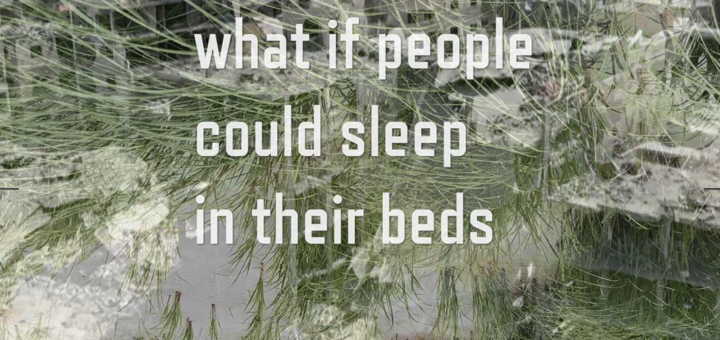
Sometime during this process, the idea for giving a voice to the fish emerged. What had they seen? How would they react to the disaster engulfing them? Who would they blame? If they had the words, what would they tell us? And so my video, DEADEYE, evolved quickly, using text based on these questions, a sequence of slowly evolving still images of the eyes of dead fish, and a soundscape built up from underwater audio recordings I had made during the summer preceding the bloom.

I started this article saying that all art is political. The politics around the bloom have been bitter and divisive. People want both blame and answers. Government wants to lead but escape responsibility. As a consequence, public forums in social media and the press have been clouded by conspiracy theories, spin, and straight-out fabrication or misrepresentation.
But the biology of the bloom is complicated, spanning all levels from the various ecosystems down to the molecular interactions of algal toxins and their cellular targets. There are many unknowns and there are few easy answers. My website is the only publicly available resource that pulls together what is known about the algal toxins and how they interact with different organisms including humans. Other citizen science sites provide the most complete reports of the effects of the bloom on different aspects of the ecosystems. That these sites are needed speaks to the failure of political process to provide the public with the information that they seek.
Art presents an alternative way of dealing with this ecological crisis and its social ramifications that complements the detailed science describing the bloom. Most importantly, artists can produce work that can say “This is what it feels like”. Critically, “what it feels like” is different for every artist and every person who views any artwork. This interaction between the artist and the viewer, as mediated by the work, is necessarily influenced by the life experiences of everyone involved. Those life experiences, and how they are valued, are unavoidably embedded in the political frameworks within which they have transpired.
Art and science cooperate to share our knowledge of the world and to communicate our reactions to it. In both art and science, it is always impossible to know in advance how effective our work will be and how far its influence might spread. But if just one person realises “Oh, I didn’t know that…” or admits “I’ve never looked at that way…” or tells a friend “That’s exactly how I felt…”, then that is success. We have strengthened our community by that little bit. And all those little bits add up. In time, with more inputs, more communication, with more work, ideas and attitudes will change, hopefully in a direction that will lead to better outcomes for the environment and everything that lives within it.
I am an optimist by nature but I am deeply pessimistic about the future of the world as we know it. But we can only do what we can. That is the primary driver behind most of my recent video art. DEADEYE will not fix a single thing about the dreadful algal bloom. But it might change a few minds, it might nudge someone into action, it might make an impression on a decision maker, and who knows where those small steps may lead.
DEADEYE, HD video, stereo, 07:10 (2025)
This is the entry link on my website to information about the toxins in the algal bloom. There you can also find links to the various Government and citizen science sites dealing with the bloom:
https://www.iangibbins.com.au/science/citizen-science/south-australian-harmful-algal-bloom-2025/