ON THE CUTTING EDGE FIVE: Romances without Words / In Solitary – Larry Beckett’s Translation of Verlaine A Spirited Misreading
A Spirited Misreading of Romances without Words / In Solitary –
Larry Beckett’s translation of Paul Verlaine’s Romances sans Paroles and Cellulairement
by Marc Zegans
“The soul of an immortal child,” says one who has understood him better than others, Charles Morice, “that is the soul of Verlaine…especially, the unceasing renewal of impressions in the incorruptible integrity of personal vision and sensation.”[i]
As an author concerned with the conditions that define, sharpen, and successively replace cutting edge verse, I’m grateful to Larry Beckett for introducing to contemporary English-speaking audiences the transformative poems in Verlaine’s famed Romances sans Parole, and Cellulairement, his recently gathered prison poems,[ii] translated now, for the first time, into English. In fitting homage to their author, Beckett uses these poems as symbolic agents that evoke the physical and moral conditions, the love, spiritual, and sexual relationships, passionate spirit, psychological torment, and urgent need to communicate that filled the life of this man who, eroding and displacing the binding strictures of poetic tradition, freed French verse from the vice of hieratic technicians.
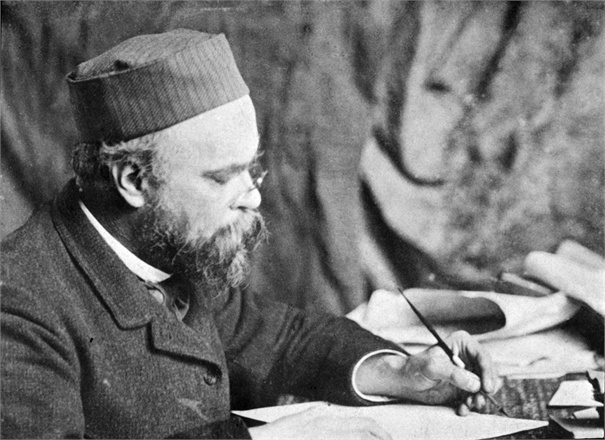
PAUL VERLAINE (1844-1896). Credit: Album / Oronoz
Central both to Verlaine’s persona and to his poetic innovations was a rare capacity to dispense with social constraint and to write transgressive scripts. Beckett’s pairing of Cellulairement with the better-known Romances sans Paroles vivifies the evolution of Verlaine’s poetic affinities, and the motives and the methods that gave rise to the Symbolist movement. And it foregrounds the progression of Verlaine’s craft under two contrasting permission structures: libertine self-expression,[iii] and supplicating entreaty for grace, embedded in deep worldly sorrow.
As a translator, Beckett neither fetishizes the original text, nor does he aim for functional, poly-systemic, or deconstructive interpretation. He is not interested in assigning philosophical priority either to an element of the text or to an interpreter’s operations. Instead, Beckett provides a loose, vital, contemporary (mis)reading[iv] that succeeds in bringing Verlaine, the man behind the poems, to life.
Characterizing storied and mythic figures—from “Song to the Siren,” co-written with Tim Buckley in 1967, through his magisterial gathering of verse epics in American Cycle, to his recent Book of Merlin, a reimagining of Geoffrey of Monmouth’s medieval (circa 1150) Vita Merlini—is central to Beckett’s oeuvre. In this translation, in contrast to prior work, he vivifies Verlaine not by narrative account but through the poems themselves. Beckett’s informal language and controlled shape of line, bringing a familiar American tone and a pronounced beat structure to the effort, are his means of animation. Reading Beckett’s translation is to find oneself in the room with the debauched, hedonistic, young Verlaine, and with the tortured, isolated, conflicted, unreliably repentant prisoner, who, awash in shame, turns to the Christian church he willfully abandoned during his wild eighteen-month ride with Rimbaud. It is to meet the man whose appetites and moral struggle gave rise to a poetics that, forswearing conventional French verse’s historicism and academic formality, fathered the symbolist movement and unleashed a century long cascade of innovations in French verse.
The strong poetry Beckett makes from Verlaine’s verse demands no less than its own spirited misreading. That, I shall attempt here. In what follows, I discuss some features, aspects, and particulars of his vibrant translations of Romances sans Paroles and Cellulairement. I concentrate in the former on Beckett’s approach to translation, and in the latter, on the evolution of verse in this lesser-known collection. I do hope that you find in these admittedly imperfect perceptions more than ample reason to take up Beckett’s novel translation.
ROMANCES SANS PAROLES
Romances Sans Paroles, largely written during Verlaine’s travels with fellow poet Arthur Rimbaud. drew inspiration from the lyrical beauty of Mendelsson’s eight books of short works for piano, “Leider ohne Worte,”[v]restoring music to the poetic line at a moment when French verse had gone flat and dry. Taking lived experience as his subject matter, substituting symbol for specification, and eschewing narrative clarity in favor of mood, nuance, and emotional resonance, Verlaine, in Romances sans Paroles, shifted the landscape from the didactic rhetoric, ornate formality, and classical motifs of the dominant Parnassian movement toward looser, less cultivated, more vital sources of inspiration.[vi] Verlaine’s self-referential turn, twenty years before Freud performed the unconscious, ruptured the conventions of French art and verse, shifting power from guardians of the tradition to individual artists and poets guided by their passions, preoccupations, and lived experience.
Beckett brings two versions of himself to this translation—the poet who sees the world and its major characters in epic terms, and the accomplished lyricist deeply immersed in the craft of songwriting. As epic poet Beckett’s central focus is dramatizing the libertine legend. As gifted lyricist, Beckett undertakes an innovative reworking of Romances’ text, inverting Mendelssohn’s concept of songs without words into beat driven lyrics awaiting melody, harmony, and musical arrangement—words inviting song. His procedure, rooted in contemporary American speech, delivers a sustained version of the effect Rimbaud describes in “To a Reason’s” opening line, “A drumbeat from your finger releases all sound, and a new harmony begins.”[vii] Beckett’s beat driven reconstruction of Romances endows readers with the capacity to sing through the words on the page and to enter Verlaine’s ecstasy, his torture, his filth, his call to spirit, and his heaven bound flights toward the sublime.
Consider “Birds in the Night.” Here, Verlaine describes his wife Mathilde as his beauty, his darling, and the cause of his suffering, wondering if she remains his “patrie”, a creature, as young and as wild as his homeland.
Vous qui fûtes ma Belle, ma Chérie,
Encor que de vous vienne ma souffrance,
N’êtes-vous donc pas toujours ma patrie,
Aussi jeune, aussi folle que la France?
End rhyming souffrance and France, Verlaine entangles notions of love, home, and suffering in this reductive conceit. Beckett elides, instead, the rhyme, and conflates country with homeland, erasing the distinction between political unit and locus of cultural belonging that Verlaine stressed by his choice of “patrie,” homeland, over “pays,” country:
You were my beauty,
My darling, my suffering,
And always my
Country, so young, so crazy!
Beckett further generalizes the proposition, removing direct reference to France, shifting the locus of Verlaine’s analogy from the place of his birth as a register of belonging to the poet’s young country,[viii] as a thing possessed. Because the generic appellation “my Country, so young, so crazy,” readily applies to the wild, young land described by Tocqueville and portrayed in Beckett’s American Cycle, decontextualizing the reference not only contemporizes but sharply Americanizes the text.
Having opened a door to the American vernacular with “Birds in the Night,” Beckett invokes the blues, employing the idiom as a recurring device, to capture Verlaine’s anguish and his delight, reducing the French poet’s more sonically complex, but less rhythmically precise lines, to impeccable blues phrasing.
Long as you wiggle,
My blues are back.
…I’m tired of the holly,
The firs and the view,
I’m tired of it all,
Except for you.
Like John Lee Hooker’s “Boom Boom,”[ix] these lines point straight to the body. To directly encounter their viscerality, try singing the verses from “Spite,” quoted above, responsively with the classic guitar lick on Muddy Waters’ “Mannish Boy.”[x]
Beckett’s sharp songwriting skills carry throughout the text, appearing with telling effect in his translation of “Dansons la Gigue,” “Let’s Tango!”
I loved the pretty lies
Like the stars in the skies
In her malicious eyes.
Let’s tango!
She had ways to uncover
And desolate a lover;
It was so charming of her!
Let’s tango!
As a refrain, “Let’s tango!” is arresting, and far sexier than the original — “Let’s dance the jig”— though not, perhaps, more so than David Bowie’s iconic cue, “Let’s Dance,”[xi] Beckett’s tender being entwined with desire for things lost, Bowie’s, fully situated in the present.
In pursuing his epic project, Beckett takes broad interpretive liberties, proceeding by appropriative subversion: animating the character, while engagingly reshaping and contemporizing the material. Though playing loosely with the poems’ language, Beckett consistently situates his translations in tight formal structures. His rigor in satisfying these stanzaic strictures conveys a sense that he is engaging in some degree of emotional distancing.
This might be read as a sophisticated, quasi-ironic posture, drawing attention to Beckett’s role as a pawky reader operating on a body of work written a century-and-a-half earlier. Yet there’s an opaqueness here, one that appears also in his recent translations of Jacques Brel’s songs,[xii] a step back from, without abandoning, the emotion that suffuses the originals. This pattern has a distinctly American male aspect, a reaching toward voices outside the norms of American masculinity for something missing, yet a tamping down, rather than integration and full expression of what is found there.
In “Beams,” the final poem in Romances Sans Paroles, Verlaine crosses a crucial turning point in the development of his symbolist verse and arrives at the culminating statement in his romantic dream. Earlier poems in Romances incorporate symbols as elements, but none is fully anagogic.[xiii] “Beams,” by contrast, in Beckett’s translation, is a unified projection—a wish for dispensation consolidated into the image of Verlaine’s wife, head held high, joyously free from shame.
Beckett’s “Beams” opens with a woman dreaming that she is “walking on the waves.” A literal translation would simply observe, “She wanted to walk on the waves.” The distinction is important. The strict account introduces a dream woman whose image can point to a variety of possible referents, among these: Rimbaud, a passing glimpse of a woman who triggers a fantasy, Verlaine’s abandoned wife Mathilde, or poetry personified. Because it situates the poem in gestural space—ambiguous in motive and intent, varied and shifting in possible meaning, refusing reduction to a static interpretation—faithful translation, in this instance, is connotatively expansive.
Shifting the image from a dream woman’s expression of desire to a woman’s dreamed experience, has the opposite effect. Positioning the woman as the dreamer, not the dreamed, places her relationship with Verlaine at the poem’s center, strongly implying that the unnamed “She” is Mathilde, and that the ensuing action is the fulfilment of his wife’s imaginative conceit.
With a beam wind blowing on the calm,
We, giving ourselves to her craziness,
Went strolling on our salty way.
When Mathilde turns to face Verlaine at the poem’s conclusion,
… a little anxious,
Not believing our faith would hold,
But seeing us joyous in her circle,
She went on walking, her head high.
We are given to believe that her perception of the joyous two—which could be an extension of her appreciative system to include Verlaine and Rimbaud, the “us” being ambiguous—signals that their bond will remain. In this light, Beckett’s “Beams,” reads as an imaginative bid to preempt the pain that will precipitate Verlaine’s desperate quest for moral redemption, and as a precursor to and natural segue into the more complex symbolic landscape that will emerge from the prison poems that follow.
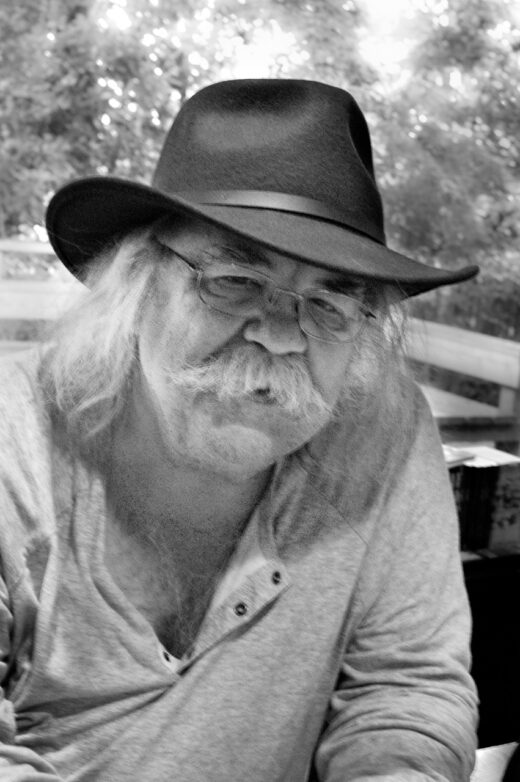
Larry Beckett
CELLULAIREMENT: Verlaine Struggles to Rewrite Himself and Rewrites Poetry Instead
In this intense, tortured, and passionate collection, Verlaine seeks reform, spouts nostalgia, voices regret at the humiliation he visited upon his wife, recognizes a self-gone-wrong and, diverges sharply from the Parnassian formalism that had held contemporary French verse in its grip. In “Dear Reader,” a prefatory poem, Verlaine describes Cellulairement as a man’s dreams in illness offered in good faith and acknowledges that he has been pilloried for his actions.
let’s just say
That I’ve been maladroit.
I lost my life, and I know all
The blame showers on me
The poems that immediately follow unfurl via a highly personal, at times childish, poësie, made manifest in the appeals for mercy and for brotherhood found in “Another.”
I’m in this scared circus,
Submissive, too,
And ready for
Anything bad.
And why, if I’ve gone
Against your wishes,
Society, go
Easy on me?
Let’s go, brothers, thieves,
Sweet vagabonds,
Swindlers in bloom,
My good old boys,
Let’s smoke philosophy,
Go for a walk
In peace, and ah!
Nothing to do.
In “Lowlife,” a transitional poem Verlaine employs a gestural strategy incorporating illustration, vocalization, archetype, and metaphor that anticipates but—presenting complication rather than producing integration—does not achieve the symbolic depth and complexity of the later poems.
With an old man’s rasp,
In a last hurrah,
My guilt—call it my past—
Sings tra-la-la.
With a hanged man’s green fingers
On a cracked guitar,
The fool dances the future,
Elastic star.
—Old jester, enough; stop
That song and dance.
He answers —This is no
Kick in the pants; (Lowlife, 103)
His tarotic invocation of the “hanged man” “fool” and “Old jester” evoke traveling carnival—trashy, trivial, noisy, lurid, and eventually banal. In going for the cheap, Verlaine lampoons but can neither reject his huckster’s need to raise a throng nor escape the debasing effect of this compulsion. Rather, he offers gaudy “Pictures for a Penny” to the milling crowd.
At the bottom of my still,
In the fire of love, blushing. . .
Come and see my magic!
It’s so fine. Come one,
Come all. Come in, Slut!
…
That bad actor, the Jester,
Will tell your fortune. Look,
Charge It is at the till.
Come quick! Hurry, hurry!
“Pictures for a Penny’s” ticky-tack vulgarity and shoddy sleaze anticipate the vacuity of auction-driven contemporary art, the lurid films of Tarantino, and the enduring sub-cultural fetish for the sordid. And they are necessary to Verlaine’s larger project: To celebrate the hustle, embrace the profane, draw us by lures and snares into his garish masque, and nevertheless receive God’s grace.[xiv] Verlaine opens “Pictures for a Penny” by announcing the method that will lead him to remake his verse, if not, ultimately, relieve him of his torment.
“Out of sweet suffering
I make my alchemy!”
In “Old Stanzas II” Verlaine brings us back to 1870 and the dry scholastic procedures with which he broke in Romances sans Paroles, a process he extends in Cellulairement by again revising his poetry.
In the arcade, it smells like the old days,
And where are they? It’s eighteen seventy,
Back in the time of Napoleon’s nephew,
And our style was a little pedantic, like
The Master, as each did his play in verse.
…
All’s cracked: I sang in the hot weather;
Now I moan on a wet bunk in a prison.
In the stanzas that follow, Verlaine’s approach is crude and immediate, situating his reader directly in life profane—witness his sharp and deflating use of simile in “Out to St. Denis.”
We were in a bad mood, and fighting,
As the flat sun of summer spread its light
Over the vacant lot like a piece of toast;
Verlaine’s conscious centering of the mundane prefigures William Carlos Williams’ poetry of the vernacular but is presented with a crucial difference. Williams found and celebrated meaning in the ordinary. For Verlaine, life quotidian is dégueulasse. Yet his petty disgust is subordinate to a more fundamental concern. In “Criminal Love,” he voices this foundational revulsion, decrying the filthy struggle between the seven sins and the three virtues, then begging for their reunion.
O all of you, O all of you sad Sinners,
O you sweet Saints, why this hard schism?
Who haven’t made, as master artists,
One and the same virtue out of our work?
Enough, or too much, of this unequal agon!
We’re going to have at last to reunite
The Seven Sins and the Three Virtues!
Enough, or too much, of this dirty wrestling!
And here we see his attention shift toward search for adequate means by which to seek redemption. In “Bouquet for Mary” Verlaine yearns to raise his voice to the Virgin ear yet feels he is too debased.
I wish I could join my heart to my soul
In a canticle to the blessed Virgin Mary.
But no, I’m a poor sinner too unworthy,
My voice howling in the choir of the just
His prayerful song, to reach Mary without tainting her virtue, must, he believes, be purified by symbolic filter.
It takes a heart like water from a spring,
It takes a child in white to be our symbol,
A lamb bleating, blameless, for innocence
To come circle us with a burning crown.
And it is in this call for a “child in white…a lamb bleating, blameless” that the function of a symbol in Verlaine’s verse shifts from denotative proxy—one thing standing for another—to active intermediary between the earthbound poet and the heart of the divine.[xv] The transformation of symbol from proxy to devoted agent Verlaine achieved in “Bouquet for Mary” and the application of this device in the poems that follow allowed Verlaine to convey a call from his spirit that his sorry person alone could not, and equipped poets with a capacity to mediate between high and low, previously unavailable to French verse.
In Cellulairement’s final poem, “Last,” Verlaine speaks with God, confesses his weakness, prays to be uplifted, and, with wry sapience bordering on rue, equates the Almighty’s charms to those of evil.
Ah! Lord! What’s wrong with me? I’m all
In tears. In unexpected joy. Your voice
Is good and evil to me at the same time,
As good and evil have the same charms
Having railed in “Criminal Love,” against the corruption of pitting sin against virtue, and having called upon saints and sinners to render their work with comparable integrity, he now extends to the voice of God the polarity it per force must encompass, for the God of all cannot be one-sided, and yet the God of “Last” is something less. This God is transactional, laying a fine table in return for love.
And in return for your zeal in all this,
I’ll let you taste the still ineffable delights,
Needy and pathetic, more mirror than deity, the God of “Last” is a manipulative, richly endowed narcissist applying coercive means to cumulate praise. Awash in self-pity, Verlaine shamedly appeals to this embodiment of conditional providence for help. God rejects the poet’s claim of incapacity and tells him to “Offer blossoms of repentance by choice.”
So, what has delivered Verlaine to this place?
Romances sans Paroles is the outpouring of his libertine break with the weak and demanding stern father morality imposed by his religious upbringing. Cellulairement is an expression of his return in mournful disgrace to that same religious precept.[xvi] Sadly, what has changed is not the God he sees but his desire for, relation to, and form of frustration in eliciting compassion from this immutable figure.
And yet I seek you, so long, feeling for you.
I wish your shadow would cover my shame.
The flailing about and the piteous entwinement of pathos and hope that pervade Verlaine’s prison poems display extraordinary poetic innovation, but not moral evolution.
And full of low-down prayer, yet trouble
Is obscuring the hope your voice reveals,
As I breathe in, shaking. . .
Poor soul, that’s it!
Exiting prison on January 16th, 1875, Verlaine has found neither peace nor redemption. He departs instead possessed of the method that will guide his creative efforts for the remainder of his life.
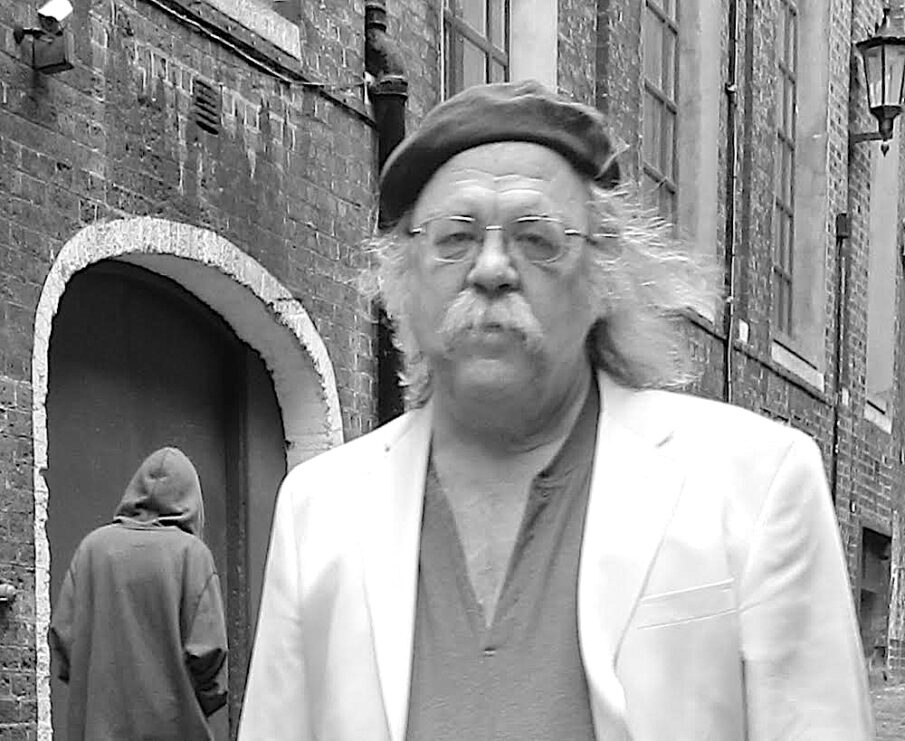
Larry Beckett
Beckett’s Resounding
Beckett’s paired translation of Romances sans Paroles and Cellulairement delivers to his readers both the experience of exhausted capitulation that Verlaine had reached by the end of his prison term, and the urgent sense of new possibility that his fellow poets must have felt on encountering this work—a profound recognition that something greater has been achieved, and that poetry could never be the same. That these innovations were seeded in a time of reckless abandon and subsequently birthed during a period of searing torment, reminds us that work which changes how we see and which alters the scope of what we can achieve is rarely abstract to those who make it. Work of such enlivening potency emerges from hard experience, intense struggle, and determined effort. To live on the cutting edge is to bleed. Intoning the beat that moves all blood, Beckett’s Romances without Words / In Solitary revives Verlaine—his mad freedom and his agon. That is its gift.
…………………………………………………….
[i] Arthur Symons, The Symbolist Movement in Literature (London: William Heinemann,1899), p.85.
[ii] The prison poems were written by Verlaine while incarcerated for shooting Rimbaud, completed 1875, and published in their entirety as Cellulairement Suivi de Mes Prisons, edited by Pierre Brunel, for the first time by Gallimard in 2013.
[iii] On the ethics defining the limited grounds for professions and professional institutions “minting moral permissions” see Arthur Isak Applebaum. Ethics for Adversaries: The Morality of Roles in Public and Professional Life. (Princeton: Princeton University Press,1999). The case on this view for individual whim in the stamping of moral hall passes is weaker still, made plain by Verlaine in his prison poems. While there’s something eternally sexy about a rock star poet flouting social convention whatever the cost, authoritarians employ the same logic in setting themselves above and outside moral constraint.
[iv] On meaningful misreading, see, Harold Bloom, A Map of Misreading (New York: Oxford University Press, 1975), and The Anxiety of Influence: A Theory of Poetry (New York: Oxford University Press, 1973).
[v] Book 1, Opus 19b, 1830…Book 8, 1842-5. Fauré, following Mendelssohn’s influence composed for piano three “Romances Sans Paroles” Opus 17, 1863, Though these were composed prior to Verlaine’s collection of poems, they were published in 1880, well after the release of Verlaine’s book and did not influence its composition. Fauré later became enamored of Verlaine’s work and set several Verlaine poems to music (e.g. Cinq Mélodies “de Venise”, Op. 58, 1891. https://www.youtube.com/watch?v=tJb33AwyJjw&list=RDtJb33AwyJjw&start_radio=1 ; La Bonne Chanson, Op. 611892–94. https://www.youtube.com/watch?v=1nnIU1eDe8s&list=RD1nnIU1eDe8s&start_radio=1 )
[vi] The Parnassian movement in 19th Century French poetry, backward looking in its affinities, placed craft and classical subject matter above the florid sentimentality and worldly involvement of the Romantics. Responding critically to the movement’s intellectualism and valorization of workmanship in shaping artistic process, Gerad Manley Hopkins in a private letter to William Mobray Baillie (September 10, 1864) wrote, “The second kind I call Parnassian It can only be spoken by poets, but it is not in the highest sense poetry. It does not require the mood of mind in which the poetry of inspiration is written. It is spoken on and from the level of a poet’s mind, not, as in the other case, when the inspiration which is the gift of genius, raises him above himself.”https://www.poetryfoundation.org/articles/69476/selections-from-hopkinss-letters
[vii] Timothy Hampton, Bob Dylan: How the Songs Work (Zone Books 2020), p. 3. I view Hampton’s translation as more elegant than Ashbery’s “A tap of your finger releases all sounds and initiates new harmony.”(https://www.poetryfoundation.org/poetrymagazine/poems/54557/to-a-reason ) and Paul Weinfield’s, “Your finger tap on the drum sets every sound free. And so begins the new harmony.” (https://paulweinfieldtranslations.wordpress.com/2019/09/13/arthur-rimbaud-to-a-reason/’’
[viii] The Third Republic was newly formed at the time Verlaine penned Romances, the former in September of 1870, the latter primarily during his travels with Rimbaud in 1872 and 1873.
[ix] John Lee Hooker and the Groundhogs – Boom Boom (The Beat Room, BBC2, October 5, 1964). https://www.youtube.com/watch?v=yLOXCzobsT4&list=RDyLOXCzobsT4&start_radio=1
[x] Muddy Waters, Mannish Boy (Chess Records, 1955). https://www.youtube.com/watch?v=Wl0xvB-U6vU&list=RDWl0xvB-U6vU&start_radio=1
[xi] https://www.youtube.com/watch?v=c4O6l6O-tgA&list=RDc4O6l6O-tgA&start_radio=1
[xii] Though We Only Have Love: The Songs of Jacques Brel, Larry Beckett and Stuart Anthony (The Orchard/Sony, 2026).
[xiii] On anagogy, see Northrup Frye, “Anagogic Phase: Symbol as Monad,” in (Anatomy of Criticism: Second Essay, Princeton University Press, 2020), p. 115.
[xiv] Following the title of Belgian historian Luc Sante’s, Low Life: Lures and Snares of Old New York (Farrar, Strauss, and Giroux, 1991).
[xv] In Not Here, Not Now: Speculative Thought, Impossibility, and the Design Imagination (MIT Press, 2025), Anthony Dunne and Fiona Raby characterize models as surrogates, simple substitutes for a more complex reality whose freedom from limiting detail invites and welcomes “imaginative occupation.” Models in their view are endowed with a limited form of agency that consists in a “wish to act as a simulacrum for another object,” and provide a “helpful wrongness” that invites aesthetic exploration and encourages imaginative flight. Verlaine’s use of metaphor, simile, and symbol throughout much of Romances sans Paroles bears analogy to Dunne and Raby’s description of a model. These devices, though more connotative in nature than a model and not intended to serve functional ends, act as analogues to less penetrable and perhaps more complex aspects of reality. And it is not beyond reason to impute to them the sort of agency that Dunne and Raby ascribe to models—the wish to serve as proxy for other things. Indeed, there is something wordlessly romantic in assuming that these small substitutions possess innate desire to stand for the things that go unnamed. Beginning, though, with “Beams” at the end of Romances and reaching full force in Cellulairement’s religious poems, Verlaine’s symbols no longer play the role of simple proxy. They become intermediating voices endowed with a more powerful and potent form of agency than that inhering in a proxy— the capacity to speak for a fallen other.
[xvi] On strict father morality, see George Lakoff, (Moral Politics: What Conservatives Know That Liberals Don’t, University of Chicago Press, 1996).

32 responses to “ON THE CUTTING EDGE FIVE: Romances without Words / In Solitary – Larry Beckett’s Translation of Verlaine A Spirited Misreading”
This is a glorious piece of writing taking you deep into the worlds of Verlaine and Beckett. Bravo, Marc!
Thank you Sarah. It was great pleasure working on this. Thank you for giving it a home.
As sure-handed an exegesis of Verlaine as I have ever read.
The book: Thank you for bringing to light this important book. I find the book available to me both in single poems and as a wonderful read through the whole thing. Having learned a small amount of French over the years, I love having the French en face – it allows me to more completely understand the translation. Often “old” poetry is interesting to me but I don’t relate to it on a personal level. This book, however, feels like a human experience that I can connect with.
The Review: I often struggle reading poetry. My mind mostly lives in the concrete. Your in depth reading of this book, pointing out how different aspects of Beckett’s writing world influenced the translation, and your notations about the path of these poems (style shifts etc), helps me not so much with an understanding – are we really supposed to “understand” poetry? – but with helping me feel the poetry and hear the music.
A good translation ought to, it seems to me, transmogrify the soul and spirit of a poem … and it appears as though that’s exactly what’s going on here. Thanks for the introduction!
Terrific article, Marc! Verlaine has been one of those poets who has sat in the background of my reading without me ever really engaging with his work. I am also fascinated by the process (and art) of translation. So your analysis of this Beckett / Verlaine collaboration (?) hits a double sweet spot for me. I’ll be looking forward to this book (not available in Australia yet).
All artists, secretly or otherwise, want the reader to dive into their work, and even express back to the poet, their own journey of discovery within it. What you have delivered Marc, is that in banquet form. A brilliant set of insights, that dance with the poetry. Verlaine is such a deep and complex character, who yet, can distill into child like wonder and petition. Beckett no doubt, recognised a spirit not too far from his own, in that regard. Larry is a serious and playful poet, and has no trouble presenting you with both modes, simultaneously. I read all of the Verlaine works, as Larry translated them and, yes, you are in that prison with Verlaine. You dream the sky with him and feel the damp of the cell walls, that don’t see to be as thick and imprisoning, as you might have thought. His struggles with God betray stern Catholic doctrine of sin, which is a shame, as the God of the gospels has more liberation in him than anything dreamed by 19th Century French Catholic guilt, that it would wish to lay upon us. ‘Neither do I condemn you’ says Jesus. I feel empathy for Verlaine, and, a man who struggled like he did, would no doubt be gratified that Mr Beckett has re-lit the altar candle of his poetry, and how.
All artists, secretly or otherwise, want the reader to dive into their work, and even express back to the poet, their own journey of discovery within it. What you have delivered Marc, is that in banquet form. A brilliant set of insights, that dance with the poetry. Verlaine is such a deep and complex character, who yet, can distill into child like wonder and petition. Beckett no doubt, recognised a spirit not too far from his own, in that regard. Larry is a serious and playful poet, and has no trouble presenting you with both modes, simultaneously. I read all of the Verlaine works, as Larry translated them and, yes, you are in that prison with Verlaine. You dream the sky with him and feel the damp of the cell walls, that don’t see to be as thick and imprisoning, as you might have thought. His struggles with God betray stern Catholic doctrine of sin, which is a shame, as the God of the gospels has more liberation in him than anything dreamed by 19th Century French Catholic guilt, that it would wish to lay upon us. ‘Neither do I condemn you’ says Jesus. I feel empathy for Verlaine, and, a man who struggled like he did, would no doubt be gratified that Mr Beckett has re-lit the altar candle of his poetry, and how.
It fleetingly crossed my mind back in 2022 after spying the monument of Verlaine whilst sitting in Jardin du Luxembourg in Paris with Larry Beckett, Stuart Anthony, Laura Fletcher and my partner Helen, the similarities between Verlaine and Larry Beckett’s poetry. Not that two poets are ever the same, but the depth of love and the appreciation for the beauty of things that we are apt miss in every day life in our harries stretches across the centuries as if warning of our ever-decreasing time here from the moment of our first breaths – along with the pains of love and the mental battering rams of life, show that while all changes around us, words, poetry and emotion remain.
Unpacked here so superbly and succinctly by Marc, this is a fascinating and poignant insight to Larry’s new translations of Verlaine and the similarities of two poets two centuries apart standing back to back one facing East, the other West, but still seeing the same things. Thank you, Marc for this fascinating insight.
Thank you so much Paul for your kind comments, and for the wonderful context you have offered about the origins of Larry’s fine new translation. I love the image of the two poets back to back, one facing East and one West, two centuries apart.
addendum to my prior comment: Happy to have found the book available for worldwide sales at Asterism Books: https://asterismbooks.com/product/romances-without-wordsin-solitary-paul-verlaaine-paul-verlaine
MARC : an extraordinary work of exposition on your part-how your carefully crafted piece brings L B’s project to life . How fortunate LB is to have you as a reader/listener/writer and how fortunate students and readers of Verlaine are to have LB’s rejuvenation of Verlaine who has been in the Pop world totally overshadowed by his bad boy intimate …Your footnotes are an education in itself -which sent me back to Jacque Brel whom I confess ,due to Rod McKuen ,I’ve always harbored some sort of prejudice . Maybe LB will change that but frankly I doubt it. Leonard Cohen satisfies those sorts of musical needs for me . Be that as it may -I appreciate your sending me this piece…Ah -The cutting edge -I remember it well -It cut me up a long time ago.
If Larry Beckett’s translations can build a bridge from Verlaine to John Lee Hooker and Muddy Waters, as Marc asserts here, we’re in the hands of a sublime architect. Beckett has never gotten the credit due him for his work almost six decades ago (!) with Jeff Buckley, himself underrated and under-sung. Their collaborations were transcendent, if too brief. So happy to see Beckett forging forward in Marc’s reading of his work, alive to the present and the past.
Why am I thinking about Tom Verlaine and Richard Hell in the frame of Verlaine and Rimbaud after reading this? It simply popped up, and there it is for me to scratch my head over.
Dear Laura, Stuart, Paul, Ian, David, Dave, and Tracy, what a wonderful feast on thought and conversation you have opened. It does my heart and soul good to read, learn from, and enjoy your spirited remarks. So happy that such a fine community is forming around Larry’s book. Tracy, that Tom Verlaine and Richard Hell popped into your mind stuck me as absolutely right and made perfect sense to me, especially with the latter’s turn to literary expression in later life. Brought me back to me punk roots as well.
Many thanks, Marc. As sure-handed an exegesis of Verlaine as I have ever read.
Anything with John Lee Hooker’s “Boom Boom” will keep me reading. Marc Zegans ( as usual) has presented a masterful piece of writing of Beckett’s translations. Insightful, scholarly, thorough, and most importantly for regular Joes such as myself, accessible. Marc, out of your “sweet suffering” we can enjoy the “alchemy.” I think everyone from Verlaine to Beckett must be smiling at this gift of explication.
Thank you so much Ed. I loved that little play on Verlaine’s “sweet suffering” and “alchemy” you did at the end there!
You’re welcome Larry. A fine read it was.
Larry Beckett’s new translations of Verlaine’s prison poems, as reviewed by Marc Zegans, are uncannily timely in presenting not only personal and aesthetic considerations regarding the French poet pal of Rimbaud & the history and effects of The Symbolists, but also provides social & cultural meditations on the current cruel immigration detention policies impacting populations and homeless citizens around the globe; in particular, a lens through which to view authoritarian leaders with their own immoral and unethical Immigration, Customs and Enforcement visions.
Thank you for your comment Jim. Your turn of the lens to focus on present injustice in authoritarian enforcement of their cruel visions of immigration enforcement brings this work into the present and invites us to bear witness and to work to bend history’s arc toward compassion, kindness, freedom, and respect for all.
Many thanks for your essay.
It is vivid, learned, and suitably intoxicated by its subject — which, given Verlaine, seems almost a critical (almost moral) obligation.
I was especially taken by the way he reads Beckett’s translations not as dutiful museum work but as a kind of “American re-electrification of Verlaine”: less reliquary, more live wire; less “faithful servant,” more … How could I say it …. ? I guess I would say more like a “bluesman dragging French Symbolism into a dive bar after midnight”.
In an essay so alert to prison, crime, shame, lyricism, lowlife, repentance, swagger, and sacred begging, how does François VILLON not get at least one chair pulled up for him?
Way before Paul Verlaine shot Arthur Rimbaud (who finally died, with only one leg left, in the Marseille hosptial where both of my kids were born : “La Conception”), before the Symbolists turned sin into atmosphere, before French poetry learned to make disgrace sing, VILLON had already done the essential work: thief, killer, fugitive, jailbird, mocker, penitent, blasphemer, theologian of bad company — the man who made the criminal record sing..
He is, surely, the “Original Gangster of French poetry”.
Verlaine may be the wounded saint of bad decisions. But Villon is the missing godfather.
If Beckett’s Verlaine sings the blues from a cell, Villon is the fellow who stole the guitar, wrote the ballad, then pawned the instrument, and still somehow made it to be immortal.
So yes: the essay is rich and persuasive … But somewhere between “Lowlife,” prison poetry, and divine bargaining, one hears VILLON coughing politely from the fifteenth century and asking why nobody has mentioned his prior claim.
Cheers !
All these perceptive and richly thoughtful comments are music to my ears and give me hope for the world today … Thank you!
Mathieu, thank you so very much for your spirited and delightful response to my essay, and for so vividly making the case for Villon. He has a true and great champion in you. I particularly enjoyed this marvelous line from your comment, “If Beckett’s Verlaine sings the blues from a cell, Villon is the fellow who stole the guitar, wrote the ballad, then pawned the instrument, and still somehow made it to be immortal.” Thanks once again, Marc
I like how the essay draws out Verlaine’s contradictions and connects them to the way he writes. I have not read Verlaine since a French lit class in college (a lifetime ago), but this invites a rereading of his work. Thank you for this thought-provoking piece.
Thank you so much for articulating how the essay spoke to you Sandra. I hope you find pleasure in the rereading.
Larry Beckett’s poetry and musicality lend a truly unique ear to these translations that I look forward to digging into with my teeth and nails when the book is in my hand. Lovely writing here Marc about the history of this work by Verlaine that I had been unfamiliar with. Who could ask for a better marriage? Do check out Beckett’s music, you won’t be sorry.
I love the pairing of Songs without words with Romance sans Parole. Kind of a Ying/Yang completion. Also that Faure was deeply moved by Verlaine.
Nice touch pairing Romance sans Parole with Songs Without Words. Kind of Yin Yang. Also intriguing that Faure was so moved by Verlaine. Writing of the highest order by Marc. Well done!
Thank you for your kind reading of the piece Stephen, and thank you very much for bringing up the Faure connection.
Thanks for your very kind note Dennis. Somehow I missed it earlier. Larry mentioned that you’d posted it to me today, so I went back and read it with great enthusiasm.
Thanks for tipping me off about this, Marc. I haven’t read much French poetry so this was mostly new to me but you open up these figures in an engaging way. I like the vernacular touch of Beckett’s spirited misreading. Great analysis!
Thanks for your thoughtful comment Dave. I’m glad to learn that the vernacular aspect of Larry’s work resonated with you.