2023 – My Head is the Earth –Time, Poetry and the Poetry Film – Csilla Toldy
I would like to begin 2023 thinking about how poets share their responses to our ecological world situation, the planet and poetry and consequent approach to time and place. In Axis Mundi (commissioned by the Centre for Creative Practices), Hungarian writer and poetry filmmaker Csilla Toldy, (based in Northern Ireland), has brought together voices from every continent (20 different languages), in reverence and respect for this precious planet, made for Earth Day, 2021.

But this work is much more than a straightforward poetry film. It may voice a sensitive and moving poem, where the poignant first line sets the tone ‘My Head is the Earth’ but it also addresses and interrogates how time, sidereal time, can be conveyed in relation to the embodied self in the moving image. Temporality, in all its constructs (both in editing and the subjectivity of the poet/poem as translated onscreen) is central to my research practice: and I explored the changing light patterns of a single scene, shot over an entire day, in my film of Lucy English’s poem Mr Sky (2018). As such I take a delight in Toldy’s use of film and montage to convey our complex engagement with place and its relation to a turning world. We recognise we are always in ‘one’ place as the world turns, yet we have a connected sense (or energy, call it what you like) of the universal, and moreover this sense is potentially shared by everyone on the planet.
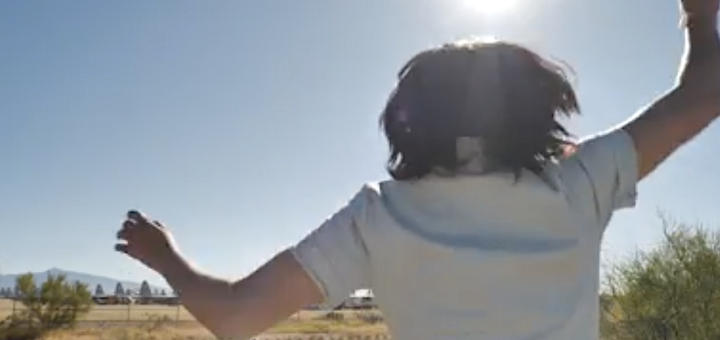
As a fixed point she centres her footage on the Meadow at Rostrevor, where, over twelve hours, twelve shots were gathered, registering, in the style of Monet, the change in light and weather. In combination she chose to use a 360–degree pan, to echo the Earth turning around its axis, and as the translated voices speak (alongside whale song), we see their time zones from zero (GMT) coming back full circle; for example, Spanish appears at + 3 degrees. She also adds a salutary ecological note: ‘I shot on Kilkeel beach last summer and was shocked by the amount of rubbish, plastic washed to shore. I incorporated some of this footage to reflect on the idea that this is the tipping point, this is the time when we have to decide whether we can save the planet and ourselves. The singing whales in the film represent the oceans and they are the very creatures who have to cope with all that rubbish, including masks, that we pour into the oceans.’
I would add that the interjecting whale song hits a nerve, a direct nerve, as if full of pathos. It reminds us, as humans, we are only part of an ecologically rich planet, and registers like a plea for us to listen and take action today.

Overall, a philosophical interrogation of time flows in and out of this work, in collecting the footage, of how the poet’s quite simple yet effective words combined with such a delivery seem to traverse a dualist position (in its multi-cross-planetary voicing). And this thereby affects how the viewer is placed, as if here and thereat the same time. Ultimately, we are all the earth,– I am the earth – and the poet suggests how androcentric time needs to now get in step with sidereal time, the time of the planet, and the beauty and vastness that gives itself every day.
ARTIST’S STATEMENT
‘Based on my poem “My Head is the Earth”, written originally in Hungarian, I asked translators from all over the world to translate and recite my poem in their own language. On Spring Equinox we filmed in Rostrevor Meadow, Northern Ireland, from sunrise to sunset every hour. On this day of the year, night and day are equal in length, 12 hours. The footage concentrated on a 360-degree circle, shot with an HD camera from the same spot, focusing on the Cooley Mountain along Carlingford Lough. We start the film at sunrise 6.27 am and as the day progresses, we go through the time zones starting from GMT, around the globe with the recitals of the poem, according to the longitude and latitude of the capital where the corresponding language is spoken. I was very pleased to get the most diverse languages such as Maori, Zulu or Farsi, Algonquin or Hiligaynon for my poem and their musicality helped me to find the rhythm for editing the footage. The translators were given free rein in how to interpret the poem or how to read it, the only distinction I made was that if I had a male reader, the poem ended with the word: light, and if I had a female reader, the poem ended with the word: night, trying to reflect on the positive-negative- yin-yang, night-day duality of our existence. 20 languages are presented, including an extinct language, Latin, in the title. The poem is read in English twice, at the beginning by a male actor and at the end by a female. The translations are read by the translators themselves, who gave their voices.
I collected the footage on the shore of the Irish Sea and at the same meadow over winter, shot from the same spot in a circle. Some of the footage incorporates flotsam – rubbish washed to shore from the Irish Sea. The visual concept of the film is footage shot through the hours of the day, the seasons in the same meadow with 360-degree pans, reflecting the shape of the earth. We move from sunrise to sunset which is only 12 hours, but the languages take us around the globe, over 24 hours. Towards the end, as we come back to Europe, the density of languages accelerates, more languages follow each other and there is an urgency, while the footage is turning darker.

The aim was to create an eco-video-poem raising awareness for environmental pollution, and also for the simple beauty of the landscape we inhabit. The combination of the footage and various languages represents the diversity of the planet, as well as humans’ dependency on nature.
I created the film with the support of the Arts Council of Ireland and Northern Ireland, commissioned by the Centre for Creative Practices. The film was award winner at the Experimental Film Festival in Barcelona and at Toronto International Women Film Festival and it was selected for Amsterdam Short Film Festival and Berlin International Art Film festival, Stockholm City Film Festival, Europa Film Festival in 2022.’
Csilla Toldy, January, 2023
For further information an interview with Csilla on the making of Axis Mundi is available here
My head is the earth,
my skin the air
dusk is my hair.
I am the earth –
I open myself
and make love
with the sky.
On my horizon
we touch
and eternity cascades
on me
with the night/light.
CSILLA TOLDY
Csilla Toldy was born in Budapest and escaped from socialist Hungary in 1981. Csilla now lives in Northern Ireland and works as a poet, writer, poetry filmmaker and literary translator. Her latest publications are Bed Table Door (Wrecking Ball Press), a novel, and Healing a poetry collection (Salmon).
Her writing has been supported by British Screen, Northern Ireland Screen, the Arts Council of Northern Ireland, and the National Lottery. As a scriptwriter, she won the Katapult and Hartley-Merrill Prizes. Axis Mundiwas an award winner at the Experimental Film Festival in Barcelona and at Toronto International Women’s Film Festival.
Poets with a Video Camera: Videopoetry 1980–2020 – some overviews

Sadly Poets with a Video Camera exhibition curated by Tom Konyves at Surrey Art Gallery, Vancouver ended on December 11th. The symposium almost didn’t happen, since a storm cut out the electricity the night before, but due to the quick-thinking and resourcefulness of the curators the whole event was moved from its original gallery location to the conference room at Surrey Library, and continued almost on its original time schedule!
One of the important points, beyond the actual films was the innovative way the gallery curators designed each film epoch to have a digital information screen at the side, which gave information about which video you were watching out of the four in that particular time period or decade. A booklet accompanying the exhibition also gave a lot of detailed information on Konyves’ thinking and the artists’ work. I believe a longer version of this is forthcoming.
Since its opening in September, there have been a number of very good overviews of this leading exhibition, and so I thought I would share them here. Moving Poems asked two of the exhibitors – foremost Canadian videopoets Valerie LeBlanc and Daniel H. Dugas to review the symposium related to the exhibition curated by Tom Konyves – ‘Two or Three Things One Should Know About Videopoetry’, that we all attended on November 5th. Valerie and Daniel have given a great account of the day and the work, with accompanying gallery photos see here: New Art Emerging: Notes from a Symposium on Videopoetry

Some of the artists being screened: Kurt Heintz, Sarah Tremlett, Heather Haley, Valerie LeBlanc, Daniel H. Dugas, Tom Konyves, Adeena Karasick, Fiona Tinwei Lam, Jim Andrews, Annie Frazier Henry and SAG curator, Jordan Strom. Javier Robledo and Matt Mullins weren’t able to attend and contributed memorable video presentations.
When Poems Transcend the Page – Poetry videos tap into the unconscious, the unspoken and the universal. Here’s why I love them
Vancouver’s Poet Laureate, Fiona Tinwei-Lam (featured on LW) also has penned a very interesting article here, which also shows her own journey with videopoetry and how poet Heather Haley’s Visible Verse festival included her first film Chrysanthemum in 2009.
And we have a recording of Tom Konyves’ talk at Surrey Art Gallery, November 26th, made by exhibitor and renowned visual and media poet Jim Andrews, from the legendary internet site www.vispo.com. More on him in due course!

Tom Konyves with his own work ow(n)ed, 2014
Many of the people and films included in the exhibition are works that are uppermost in my archive and/or included in The Poetics of Poetry Film, and I could write long essays on all of them.

Secondary Currents, Peter Rose, 1982
But as someone who has an early background in experiments with text-on-screen, and not having seen many examples lately, I have a fondness for Peter Rose’s jumbled kinetic/sound text Secondary Currents from 1982, and also Jim Andrews’ playful Seattle Drift from 1997 – his first programmed poem. The link is the interactive version, not a video: https://vispo.com/animisms/SeattleDriftEnglish.html
Jim worked with the extraordinary poet Adeena Karasick on the video of her poem Checking In (Talon Books) (2018). Here is a version without her voiceover, but you have to see her in person with the video – mesmerising performance work.
The whole event was a totally memorable experience, surrounded by so many leaders in the field. A big thank you to everyone involved.

me and Natasha Boskic

The Women’s Canvas – A Festival of Films
The Women’s Canvas – A Festival of Films (16th–19th December) is based in Kanpur, Uttar Pradesh, India. Run by women for women, with local and international filmmakers, they ‘reward the accomplishments of like-minded filmmakers who aim to create interesting and boundary-pushing content’.
Women in any aspect of film production are included with (as I estimate) over 35 awards! And exhibitors are invited ‘to participate in a variety of programs, Q&A sessions and a series of panel discussions, Press Conferences. masterclasses where filmmakers have the opportunity to discuss their work and careers with a new generation of content creators.’
I was fortunate enough to have Villanelle for Elizabeth not Ophelia included in this festival and look forward to discovering more about it in the coming days.
REELpoetry, February 2023, ecopoetry presentation, & still time to submit
REELpoetry, based in Houston, Texas and online will be with us once again February 24–26, 2023. There is still time to submit for the festival by the 19th not 15th of December, which isn’t themed this year, and entries are given prizes for the best film under four minutes and the best 4-6 minutes long.

There will be a host of different programmes apart from the exciting open juried screening: live events in Houston (Café Brasil) include: Texas Poets and Filmmakers screenings; ASL poets and performers, (a particularly important and unique feature of this festival with Sabina England now part of the team and top interpreters), an Open Mic and Deaf Open Mic, and Jack Cochrane and Pamela Falkenberg (see this site to learn more about their working methods) hosting an activist ecopoetry film screening. Online will include an online discussion with Deaf and Hearing participants; curations from around the globe – Mexico, Canada, Italy, Australia, England etc. and REELcafe networking opportunities. All in all a great lineup for a post-COVID event with Houston itself firmly back in the centre of things.
Fran Sanders, the organiser, is very active on the poetry scene in Houston through Public Poetry publicpoetry.net and, apart from the COVID hiatus has been building a strong foundation for poetry film in the city for a number of years. Submissions are via FilmFreeway: https://filmfreeway.com/REELpoetry2023
I am fortunate enough to have been part of the organising meetings and one of the judges (currently being confirmed), two of whom, alongside Fran Sanders, are: leading Australian digital artist and eco poetry filmmaker Ian Gibbins, and Canadian digital artist Mary McDonald.
As a triad Ian, Mary and myself are also making a short 40-minute video for the festival entitled:
Ecopoetry Films & Subjectivity: Behind the Making Process.
With the devastating effects of climate change, Ian Gibbins, Mary McDonald and
Sarah Tremlett present their films and discuss each other’s work and their varying
approaches in relation to the theme of ecopoetry and subjectivity.
Mary’s films will be Wishing Well (poet Penn Kemp) and Utility Pole (poet Fiona Tinwei Lam); Ian’s floodtide, and colony collapse, and mine I Cannot be Human, and Villanelle for Elizabeth not Ophelia. More to come.
FOTOGENIA, Mexico City, is back!
For a full week this year, Fotogenia festival (who I partner with at Liberated Words) and directed by leading curator Dr Chris Patch, is running from November 23rd to December 1st. At https://www.fotogeniafilmfestival.org/en it is now in its fourth edition and is packed with a broad and eclectic selection of international works and includes live events alongside an online programme. I am one of the judges of the poetry film section and the entries were very difficult to judge, although one or two were highly innovative and a real delight to watch. My poetry film Villanelle for Elizabeth not Ophelia is also in the festival programme 6 alongside artists such as Jane Glennie, Deborah Kelly and Tova Beck-Friedman in a section primarily related to women’s issues, and I am looking forward to being involved next week from an online point of view.
I think I should let the festival speak for itself:


See you there!
S
MALDITO 2–6 November, Albacete, Spain
So pleased to announce that Maldito festival in Albacete, Spain is here again, and looks to have a really versatile and compelling curation programme. I am very proud to say that it includes my interview (translated into Spanish and English) on The Poetics of Poetry Film and videopoetry with Javier Robledo, director of VideoBardo celebrating 25 years of VideoBardo festival in Buenos Aires, Argentina. My own ekphrastic poetry film Villanelle for Elizabeth not Ophelia (Spanish version), bringing to attention female suicide, is also in the programme and I wish I could be there, maybe next year.