HAPPY HOLIDAYS AND NEW YEAR
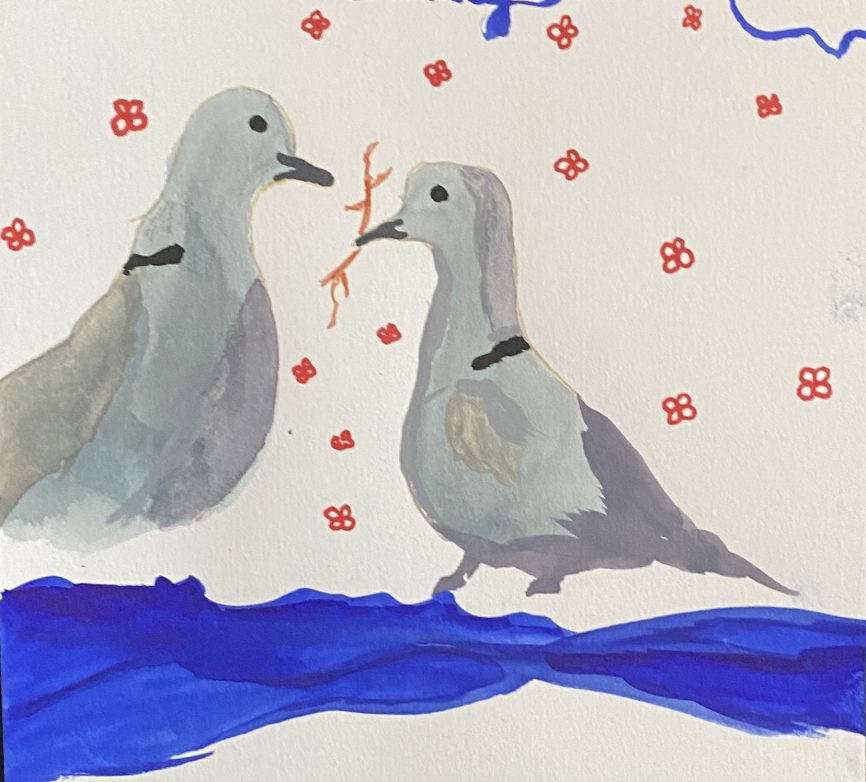
Happy Holidays and New Year to all poetry filmmakers, artists, poets etc. out there. I look forward to catching up with you in the New Year.
In the meantime here is a card my daughter Georgie painted for me (she says she isn’t an artist …) to send you flights of imagination for 2024.
Sarah xx:)
In MEXICO CITY for Winner of FRAME TO FRAMES : YOUR EYES FOLLOW II & publication
Exhausted and inspired, I have just flown back from vibrant, warm and friendly Mexico City and FOTOGENIA festival 5 – an extraordinary collection of films from across the world, at seven locations, so ably co-ordinated and directed by Chris Patch / Mtro. Christian O. Pacheco-Cámara. The sites were: Centro Cultural Bella Epoch – Cine Lido; Centro Cultural Universitario – Sala Carlos Monsivais; Terminal Coyoacan; Faro Cosmos – Baja Negra; Faro Aragon – Cine Corregidor; Barco Utopia – Auditorio Arrecife / Sala Doble Altura; Complejo Cultural Los Pinos – Sala de Cine Miguel Aleman
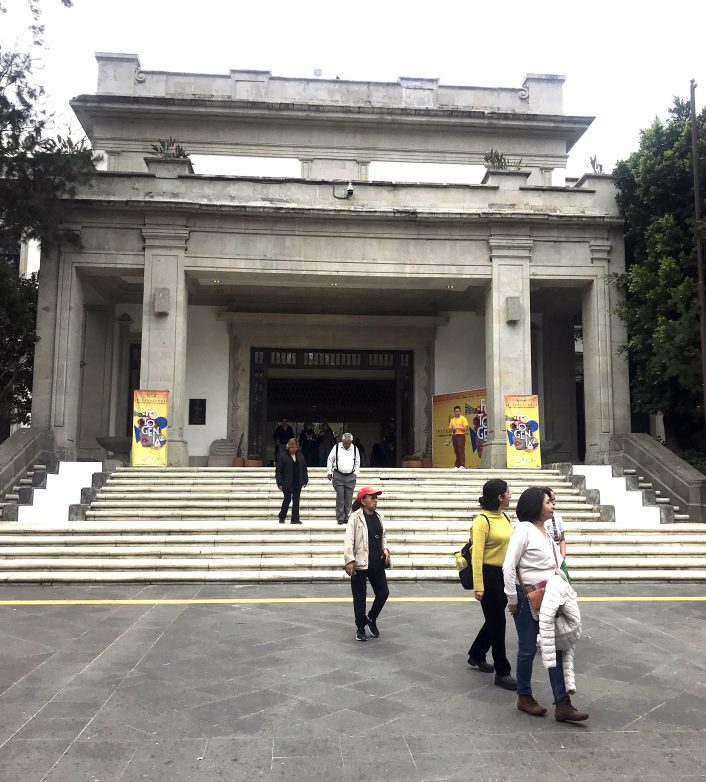
Complejo Cultural Los Pinos

I was there to see my own work onscreen (I Cannot be Human), but primarily to present the Frame to Frames : Your Eyes Follow ekphrastic poetry film prize at the beautiful Complejo Cultural Los Pinos (Calz. del Rey S/N, Bosque de Chapultepec, Mexico City). Until recently this was the official presidents’ residence, set in a vast public park amongst verdant greenery and pine trees, and it provided a fantastic backdrop to events.

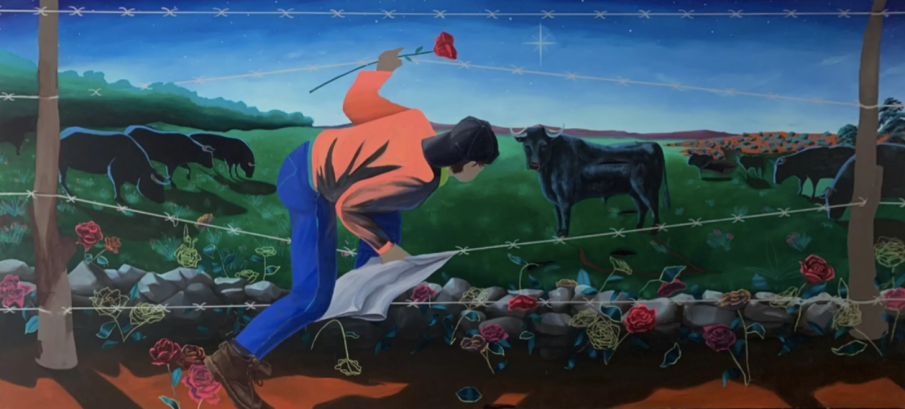
Huapango Torero by Ana Segovia
Traditionally ekphrasis suggests poems written about paintings or sculptures, but here poetry films have been created as a response to artworks that have inspired the filmmaker. As part of the screening, I was able to interview leading Mexican artist Ana Segovia on the important painting Huapango Torero which provided inspiration for many of the filmmakers. I was so pleased that Ana could attend and watch all the films in person, and he also provided a translation of my words. It was made more interesting in that Ana had also copied the painting from another painting, but with the addition of a red rose. In this way the ekphrastic process continued: wave upon wave. Whilst Ana addresses all types of outmoded machismo through his figurative painting, it was unanimously felt that he had made a brave and significant artwork, in relation to the treatment of animals.

Ana and Sarah in discussion

Ana, Sarah and Chris

Ana and Frame to Frames filmmaker Carlos Ramirez Kobra in discussion
The Book of the Films
I was also able to present the bilingual book of Frame to Frames II, as a pre-publication special offer published by Poem Film Editions. FOR SPECIAL OFFER PRE-ORDERS of £5 (50% off £10 retail price) contact liberatedwordspoetryfilms@gmail.com
It includes an introduction from myself, leading American ekphrastic poet Janée Baugher and other artists; the poems, stills from the films and a QR code link to the screening itself. So, you can read the poem and watch the films at the same time. It celebrates translation in all its forms!


The Prizewinner for Frame to Frames : Your Eyes Follow II
It was very exciting to also announce the winner for this year’s edition of the prize. The judges felt that all the films were extremely innovative and memorable both in the poetry and the filmmaking and it was difficult to reach a decision for a single prizewinner. To explain the process: the judges selected five artists from 16, and then met to discover if they had overlapping choices and discuss each film in more detail.
I am so happy to announce that the prize this year goes to British poetry filmmaker, writer, artist and nature photographer Meriel Lland for A Love Spell Cast in Petals based on the painting Huapango Torero by Ana Segovia. Meriel was very high on both the judges’ lists, so congratulations and thank you so much for your wonderful film! I have to put my hand on my heart and say I am overjoyed that Meriel should be given the award. I also want to add that I abstained from influencing the process as I know her well.
Words and concept: Meriel Lland
Photography and camera: Michael Leach and Meriel Lland
Editing: David Lland and Meriel Lland
Animation: David Lland
Sound: David Lland
Translation: Camilo Bosso
Meriel’s synopsis:
‘A Love Spell Cast in Petals weaves together threads from many sources. Most importantly, Ana Segovia’s flower offering in her painting Huapango Torero – and the painting of the same name that inspired it – but also the 1950s’ Lola Beltrán song ‘Huapango Torero’ and the once banned 1936 children’s book The Story of Ferdinand by Munro Leaf. The film-poem explores what happens when we dare to think differently and challenge the cruel stereotypes that misrepresent and trap a living being. It refuses the theatre of machismo to remake old understandings of bulls and of men. The painter is a peace-maker, she invites new dialogues and encourages forgiveness and an end to violence. She is a sorceress casting a spell of hope.’
In brief, the judges said that A Love Spell Cast in Petals was complex, innovative and thought-provoking and that the sound elements were delicious and mesmerising with surprising figurative language. They loved the craft of the visual aspects – the paint, the bull figurine, the animated drawings and it was for them a clear winner.

JUDGES’ COMMENTS
‘In ekphrastic poetry films, I look for the choreography of the elements – movement, sound, image, word to create an interpretation of the original work of art. I look for these to create a new work that is built upon the spirit of the first. In her piece, “A Love Spell Cast in Petals,” Meriel has mastered this choreography. The pace, the cadence, the impact of words flowing seamlessly into and out of the play of imagery. Together, they ebb and wash over us, the viewer, drawing us in until we too are subsumed within this dance of understanding, of vision, of what has been and what will/could come. We too see, we too are seen, in this mesmerizing film poem.’
Mary McDonald, media artist, digital storyteller and poetry filmmaker
‘Brava to Meriel Lland for her complex, innovative, and thought-provoking art-influenced film-poem. The text itself, which I’d call narrative-lyrical, had a clear point-of-view, delicious sound elements (e.g. consonance, assonance, alliteration), and surprising figurative language. I particularly loved the visual varieties, such as the closeups of paint issuing off a paintbrush, human hands whittling a bull figurine, drawings in animation, and landscape photography. For me, this film—political without being heavy-handed and creative in its craft-driven relationship among image, text, and sound—was the clear winner.’
Janée J. Baugher, ekphrastic poet and multimedia artist
Meriel – a Thank You note
‘Today’s news is heart-stopping – wow! To have been made a finalist in Frame to Frames was a delight. The makers on the shortlist are all people I admire for their vision, subtlety, authenticity and invention. That A Love Spell Cast in Petals has found a place here is such an honour. Huge thanks to my team at smallestdogintheworld studio – especially to David Lland, Michael Leach, Peter and Margaret.
For me, one of the delights of ekphrastic work is the dialogue it makes possible between minds, times, places and ideas. Thank you to Ana Segovia for opening this conversation, for her brave, optimistic and daring painting. And for making me think, wonder and hope.
Thank you to Sarah Tremlett and the judging team at Liberated Words for this opportunity. And to Fotogenia for offering such a vital and vibrant celebration of voices that are all too often unheard. Together we can create spaces to challenge cruelty, break with unacceptable traditions and work towards more compassionate understandings. Thank you.‘

I See You, and You See Me

carving a bull through swirling red ‘blood’ (or paint) and rose petals
As an artist, filmmaker and lover of all creatures, I am absolutely thrilled that Meriel has been awarded the prize. She is a fine advocate for the natural world and an empathic relationship with birds and animals. I cannot think of a better person to win the Frame to Frames prize in this particular year. She has written and provided photography for 18 books all concerning nature and its importance to our wellbeing, and fully deserves to be ‘seen’ as a leading activist for animal rights through poetry film.
I also would personally like to extend my thanks to Dr Chris Patch / Mtro. Christian O. Pacheco-Cámara. Without his support and encouragement this event would not have been possible. I have watched the progress of FOTOGENIA since the very start, and in 2021 Chris interviewed me on The Poetics of Poetry Film. I am honoured to be able to be part of this festival, and share creative projects together. Thank you. Sarah

XaiLA the performer in Bull / Torero (by myself – Sarah Tremlett)

and in the ‘real’ world – early morning mother and daughter …
New imprint – Poem Film Editions & Frame to Frames : Your Eyes Follow bilingual book
I am very proud to announce the launch of Poem Film Editions, an imprint that will celebrate the link between word and image, poetry + film and of course, poetry film.
The first publication will be the bilingual (English and Spanish) book of the Frame to Frames : Your Eyes Follow ekphrastic poetry film screening. It is over 100 pages, full colour, and the introduction includes a contribution from the author of The Ekphrastic Writer: Creating Art-Influenced Poetry, Fiction and Nonfiction (McFarland, 2020) – American ekphrastic poet and cross-media artist Janee Baugher. The contents comprise poems, film synopses and a QR link to the films.
I am also thrilled to be attending FOTOGENIA this year in Mexico City, and already packing! The book and the imprint will be announced there, alongside the prizewinner, at the Frame to Frames: Your Eyes Follow screening on the 2nd December, at the Complejo Cultural Los Pinos (Calz. del Rey S/N, Bosque de Chapultepec I Secc, Miguel Hidalgo, 11580 Ciudad de México, CDMX). Please come along!! With many thanks to judges Janee Baugher and Mary McDonald. Congratulations to
Patricia Killelea, US: Tova Beck Friedman, US: Alejandro Thornton, AR: Colm Scully, IR; Janet Lees, UK (Lois P Jonesand Elena K Byrne, US); Martin Sercombe, (Thom Conroy) NZ; Pamela Falkenberg & Jack Cochran, US; Csilla Toldy, HU, IR; Finn Harvor, CA; Javier Robledo, AR; Beate Gordes, DE; lan Gibbins, (Judy Morris); Carlos Ramirez Kobra, MX; Penny Florence, UK; Meriel Lland, UK; Ana Pantic, RS; Sarah Tremlett, UK.
The publication will be available to buy from Liberated Words in January 2024 at £10.00 plus post and packing. We are currently taking pre-orders via liberatedwordspoetryfilms@gmail.com.
We have a special pre-publication offer – a 50% Discount at £5.00

I also would like to introduce writer and filmmaker Csilla Toldy as a director of Poem Film alongside myself. I have admired her poetry films and writing for some time and indeed you can find her work in the book/screening. She sends a few words:
‘I am delighted and honoured to be invited to be a director of Poem Films Editions. I wish good sailing to this new publishing endeavour of hybrid books, linking text to film poems. Good Luck!’ Csilla

Winter Latino Festivals: Lights Down & Screens are Lit in Mexico and Argentina
Festivals abound at this time of year and down in the Latino / Latinx / Hispanic countries of Latin America, the lights are out and the screens are lit for the winter celebrations.

VideoBardo, Buenos Aires, Argentina 23rd / 24th November & 1st–3rd December
VideoBardo – the oldest festival of its kind in the world – has two main screening dates the 23rd and 24th of November and the 1st–3rd of December. They have a really strong selection of films this year – their own well-chosen curations by Director Javier Robledo and Marisol Bellusci, alongside ‘Claroscuro’ curated by Helios Sun (Mexico City) director and filmmaker Estefanía Diaz y Carlos Cruz (which I am honoured to be part of with Villanelle for Elizabeth not Ophelia). There is also a very interesting curation from Russia ‘I am not a song’ by Marina Fomenko. The whole event really feels innovative yet seasoned and established. Interspersed with the screenings there are also lectures, music and performance as well as an anthology of visual poetry from Argentina and Brasil by Claudio Magnifesta and Julio Mendonca, which I really would have liked to have attended. Overall, a really memorable occasion. I will be sad to miss it as I will be presenting at FOTOGENIA in Mexico City.
IPrograma Completo_Videobardo 2023

FOTOGENIA, Mexico City runs more or less continuously from the 22nd of November to the 3rd of December this year. I am so proud to announce that I am there for the screening of Frame to Frames : Your Eyes Follow ekphrastic poetry film prize, where, with artist Ana Segovia I will also be announcing the winner and learning more about her work. This event is one of the special programmes (no. 3) on December 2nd at 4pm at the Complejo Cultural Los Pinos (Calz. del Rey S/N, Bosque de Chapultepec I Secc, Miguel Hidalgo, 11580 Ciudad de México, CDMX) so please come along. More exciting news on this in the next post.

FOTOGENIA with leading Director Christian O. Pacheco-Cámara aka Chris Patch goes from strength to strength, now with SEVEN! venues across Mexico City and both live and online programming. It seems to be able to combine a vast broadcasting schedule (nightmare) with experimentation and audio-visual innovation – quite a feat! There are their own curations under different thematic titles, (such as ‘Despedida’ which directly translates as ‘Farewell’ or Angustia (Anguish or Distress)), a wide cross-section of experimental films, of Mexican artists, and a number of special programmes, alongside invited programmes such as from the International Poetry Film Festival of Thuringia. Fortunately, as Mexico City is huge, you are able to tailor your live viewing according to location and day.
https://www.fotogeniafilmfestival.org/en

I also aim to attend Helios Sun Poetry Film Festival, Mexico City, that coincides with FOTOGENIA, as I have Villanelle in that, whilst two of my other films – I Cannot be Human and Bull are being shown at FOTOGENIA – an embarrassment of riches. More exciting news about Frame to Frames and FOTOGENIA in the next post!
Helios is running from the 10th November – 12th December this year. According to Film Freeway Helios has three festival locations at: Galeria el Rule, Centro de Cultura Digital and Museo Archivo de la Fotografia and I am looking forward to meeting Estefania, Carlos and everyone when I am there and experiencing the event first-hand. They say:
‘We call for the realization or presentation of short, medium and feature films that through language, narration, technique and imagination expand the territory of poetry into audiovisual formats that allow us to open our eyes and approach in an authentic way the world we inhabit . We believe that moving images are a form of poetic writing that allow us to understand and elaborate expanded language codes, symbols and imaginary through which we can connect with people.’

Photostory ‘A Painting of a House’ for Liberated Words by Charles Olsen
As part of the Word and Image section of the website I am very interested in photo stories or photo essays. I was over the moon when Charles submitted the following to me, and I think it provides a perfect blueprint for such writing, also crossing over into the terrain of travel writing, as in my essay ‘Motherland’ on Marc Zegans’ Lyon Street and visiting and reading in San Francisco.
The best things in life are so often culled from quiet observation, and writing is a testament to that. Charles’ eye for detail, stillness and space which hangs over this narrative, also can be found in his poetry film In Silence. Writing from a stay in Colombia, the account features the touchstone of Tomás – a source of inspiration… [I think that Charles knew I would like this concept very much since Tomás is a parrot!] At one point Charles is described as ‘born painted’ [and also maybe born painting] and indeed this is a word painting – a real-life scenario that slowly unfolds before our eyes.

A PAINTING OF A HOUSE
Café, sal, azúcar moreno, arroz, huevos y un plátano… instant coffee, salt, demerara sugar, rice, eggs and a banana. The surface, wiped clean to avoid the tiny mites that dart over it when food is left out. I crack the eggs into separate glasses because a couple were a runny brown mess inside even though they didn’t bob in water. The sugar is for freshly made juices—tree tomato, melon, guava.
The extractor fan above the stove is installed back to front. It blows the hot air straight back into the kitchen. I go outside to check the outer wall but there is no ventilation hole.

Tomás is 38 years old and has outlived a number of the family. I chat with him over breakfast in the patio. We listen to the birds next door. He copies their call. We listen to the radio and sometimes he dances along to a salsa tune. We listen to aunty Carmiña in the kitchen and he says quietly ‘loca’(crazy). We listen to the dogs making a racket in the street and he barks back.
Tomás is the mascot of a poetry project I began in 2011. Called Palabras Prestadas, or Given Words in English, it invited people to write poems including five words donated for the occasion. Since 2016 I’ve run the same competition for Aotearoa New Zealand’s National Poetry Day each August. Tomás donated the words to the 120th edition of the Spanish competition in 2017, where you can see a video of him swearing away in Spanish.

The next-door neighbour listens to the early morning evangelical mass. There is hardly a breeze and I’ve not slept well because of the noisy fan my wife uses. I open the glass fibre curtain hoping for a slight waft of air, come on in mosquitos—I don’t care any more; the bites on my legs are beginning to heal anyway.
I’ve got used to the bars on the windows and the doors. They mean the doors and windows can be kept open to allow a draft through the house, but my aunt closes them all at night, all except this one above my bed. I’m also used to seeing the broken glass sticking out of the dividing wall between the properties—to deter thieves. For this reason there is always a lock on the gate at the front door and another on the gate to the footpath, like a two-stage security check to sign in to your online bank.
Although he tries to bite people I begin to open the door to Tomás’s cage sometimes, so he doesn’t always feel shut in.

Carrots are fatter here than in Europe. Shorter and fatter. The local store doesn’t have courgettes and there is only one variety of tomato with little flavour.
The fridge is empty except for fruit for a week of juices. My aunt calls the corner shop for the day’s ingredients: a tomato, an onion, a green pepper, a pound of steak, a litre of coke. A few minutes later a lad is at the front gate with the shopping, his bicycle leaning on the waist-high curb.
Every house has its own footpath and steps down to the road, maybe a sloping driveway. Here I miss my twice-weekly runs. On the one hand, my wife is worried about this white European being robbed or assaulted, and on the other, where can I run? The footpath is an obstacle course with steps, walls, trees, raised gardens, narrow paths, cars parked across driveways. And there are no zebra crossings so you take your life in your hands at every main road.

There is a corner where we sit with Carmiña on plastic chairs. With our meat pasties or fried anise breads and a bottle of beer, and the amplifier next to our table playing salsa music, we watch the goings on. Unlike other intersections, here the traffic slows to a donkey’s pace to avoid scraping on the concrete. I imagine neighbours thinking it’s a good job—potholes are more effective than any zebra crossing. Cats and dogs cross languidly. A man in shabby clothes shuffles across the road to ask if we want our shoes shined. We all look down at our feet, we are in flip-flops and his toes overhang the front half of his battered shoes. A red squirrel skips along one of the many electric wires that criss-cross the street.
Yerson takes a break from painting the front fence and I tell him about wanting to go for a run. ‘Come with me,’ he says, ‘nice and early when the air is fresh.’ ‘What time?’ I ask. ‘Four thirty,’ he says, ‘before the city wakes, it’s the best time of day.’
In the evening, in the kitchen, I cut some sultana bread to eat. Tomás stirs in his cage and in a soft voice he calls ‘lorrrito, lorrrito’ (little parrot, little parrot). I cut a chunk off for him and he takes it in his claw.

Thieves can’t access the gated estates in the north so they come to the middle-class areas with their decorative wrought-ironwork fencing. In poorer neighbourhoods the doors are wide open, a television or sound system playing inside—a figure silhouetted in a rocking chair.
In the north, street signs prohibit horses and carts but here the clip clop of horse’s hooves mixes with the rough horn blasts of careering buses, the droning megaphone of a flatbed truck collecting odds and ends, street-sellers pushing handcarts and calling out the fruit, paintings, plants or furniture they’re selling, or the elegant Zoraida, a metal bowl on her head overbrimming with sweets made of coconut, sesame seeds, fruit and raw cane sugar, her gentle smile and singing voice calling ‘alegría, cocada, enyucado, caballito…’ (happiness, coconut sweets, cassava cake, papaya sweets…).
Zoraida, Zoraida! we call. Unlocking the gates, we sit and wait in the shade of the tree on the footpath while she finishes chatting with the neighbours across the road.

I want to wander the streets with my camera, to photograph every corner, house, tree, but my wife and aunt insist it’s not safe to carry the camera in the neighbourhood and especially not alone. So I’m making a poetry film of the house instead—it’s a microcosm of the city in any case and our imaginations can fill the gaps.
A gentle draft enters from the street, passes the rocking chair, down the passage and out the back door, where Tomás dozes in his cage in the patio.

Although the sun is hot, and there’s a breeze, it’s so humid that the clothes take all day to dry on the line. I make my bed and handwash my own clothes to save my aunt the bother, there being no washing machine. She’s not used to this. One morning I’m busy rubbing soap into the clothes in the outdoor sink, Tomás whistling in his cage behind me, and I turn to see my wife and my aunt both quietly watching me from the doorway—a man doing the domestic duties.
The patio is where I find my towel, which I’d left carefully folded on the bedframe so I could go straight into the shower when I woke up. I sleepily pull on some shorts and patter up the hallway to retrieve it from the line. I wonder if Tomás has a similar feeling of unease as his cage is cleaned or moved between the kitchen and patio, his bowl of rice is delivered, or people come and go in his life.
We visit the cemetery where two family members were buried during the pandemic. A mother and an uncle, a sister and a brother. The closely spaced graves are marked with simple engraved stones, and gaudy plastic flowers and spinning-wheels in bright colours stretch out into the distance. I begin to read dates and ages but stop with the sudden realisation they are all from 2020 and 2021 with young and old together.
On my last day in Barranquilla I decide to sit alone in the street opposite the house with my watercolours—after weeks only leaving the house in company this is a rebellious act. It feels like the first steps outside after an illness, or a pandemic lockdown—returning to life but also entering a different world with new eyes.

Last morning in Barranquilla. 11 January 2023.
A neighbour is playing old salsa tracks as he works on the driveway. The boy from the corner shop down the road makes deliveries by bicycle. A dog lies on the footpath in the sun. The girls next door start shouting for their dad to catch them the iguana—it crosses in front of our house and climbs the tree which is recuperating from the pruning it got before we arrived. The iguana vanishes in the foliage. Men push carts up the hill and hold them back going down—a black fridge, odds and ends. Passers-by say ‘buenos días’, ‘buena pintura’.
Yerson pops over to see the watercolour and comments on the trees, the dog, the iguana. ‘Tu naciste pintado’ (You were born painted!) he says.
Carmiña’s cooking smells good in the kitchen.
The taxi will arrive at 3pm.
Winter waits in Madrid.
—Photographs, watercolour sketch and text by Charles Olsen.
Charles Olsen (Aotearoa New Zealand, 1969) Poet, artist and audio-visual creative.
In 2018 he received the III Antonio Machado Fellowship of Segovia and Soria which led to his latest collection of poems La rebeldía del sol (Rebellious Sun, Olifante Ediciones de poesía, 2022). He has contributed essays to The Poetics of Poetry Film (ed. Tremlett S., Intellect Books, 2021) and has written about poetry film in Colombia for The London Magazine and WMagazín. Together with the Colombian poet Lilián Pallares he directs the audiovisual producer antenablue ‘the observed word’ and their poetry films have been included in international festivals and featured in Moving Poems, Poetry Film Live and Atticus Review. Their collaborative Māori language film Noho Mai, won Best Poetry Film in the 8th Ó Bhéal International Poetry Film Festival, Cork. They are also on the Jury of the Aotearoa Poetry Film Festival taking place in Wellington, New Zealand, on 2–3 November 2023. You can see more on his web charlesolsen.es and blog pensamientos lentos.
Heralding the first Aotearoa Poetry Film Festival – New Zealand
The first Aotearoa poetry film festival in Wellington is nearly upon us on the 2nd & 3rd of November. It looks an exciting and innovative event, which is not surprising since I know some of the judges and their own work, but also they say
‘In particular, we encourage the submission of innovative and eclectic takes on poetry film as a distinct media form.’

I only wish I could be there. They describe the two-day festival as featuring:
‘a poetry film competition, workshops, seminars, poetry readings and retrospectives and it will offer the opportunity to showcase the diversity of poetry film produced both in Aotearoa New Zealand and overseas. The 2023 Aotearoa Poetry Film Festival is organised in collaboration with Victoria University of Wellington, Wellington UNESCO City of Film and Lighthouse Cinemas.’

La Vie en Rouze, Elle Kunnos de Voss
https://www.aotearoapff.com/program-apff-2023
The jury for 2023 are:
What is also interesting about this event is the New Zealand retrospective which will set a historical stamp on poetry film in the country. Finalists have been selected in the international, student and New Zealand categories, and they are:
APFF 2023 Finalists
International Category
The Distance Between the Staircase and the Sky – Katerina Athanasopoulou 7:0
When it Feels Hot, That Rage Against Me – Helmie Stil 1:50
Draft – Agustín Vallejo 4:00
Shades of Gray – Lyon Pol 2:57
Transparency of the Sole – Diek Grobler 3:50
La Vie En Rouze – Elle Kunnos de Voss 4:10
Student Category
This Was Meant to Be For Nora – Deanne Angelina Emery et al. 2:58
Sorry, Mum – Jono Li 1:40
The Carousel – Florian Schlotzhauer 3:00
New Zealand Category
How to Fly A Kite – Trixi Rosa 3:02
House Plant – Ellen Jones-Poole 2:28
Ngākau – Komako-Aroha Silver 6:50
Supernova – Flora Xie 3:59
Waves of Ghosts – Jack Nicol, Andy Day, Dominic Hoey 3:34

The Mask, Martin Sercombe
New Zealand Poetry Film Retrospective
Acknowledgements – Arvid Eriksson 3:30
No Losers @ WINZ – Tourettes 3:38
There is a scratch on the inside of my right knee – Will Cho 3:25
Do Not Go Gentle – Luke McPake 3:28
Edgewalker – Ursula Grace 3:16
Storytelling – Martin Sercombe 9:01
The Mask – Martin Sercombe 4:01
One Sunday – Martin Sercombe 5:49
Urban Landscapes – Charles Olsen 5:11
Llanto Congelado – Charles Olsen 5:11
The Existential Machine – Paul Wolffram 6:07
Inferno – Shu Run Yap 2:14
Butterfly – Alfio Leotta 6:59

The Carousel, Florian Schlotzhauer
Congratulations to all finalists and the organisers for what will be a really special and memorable event.